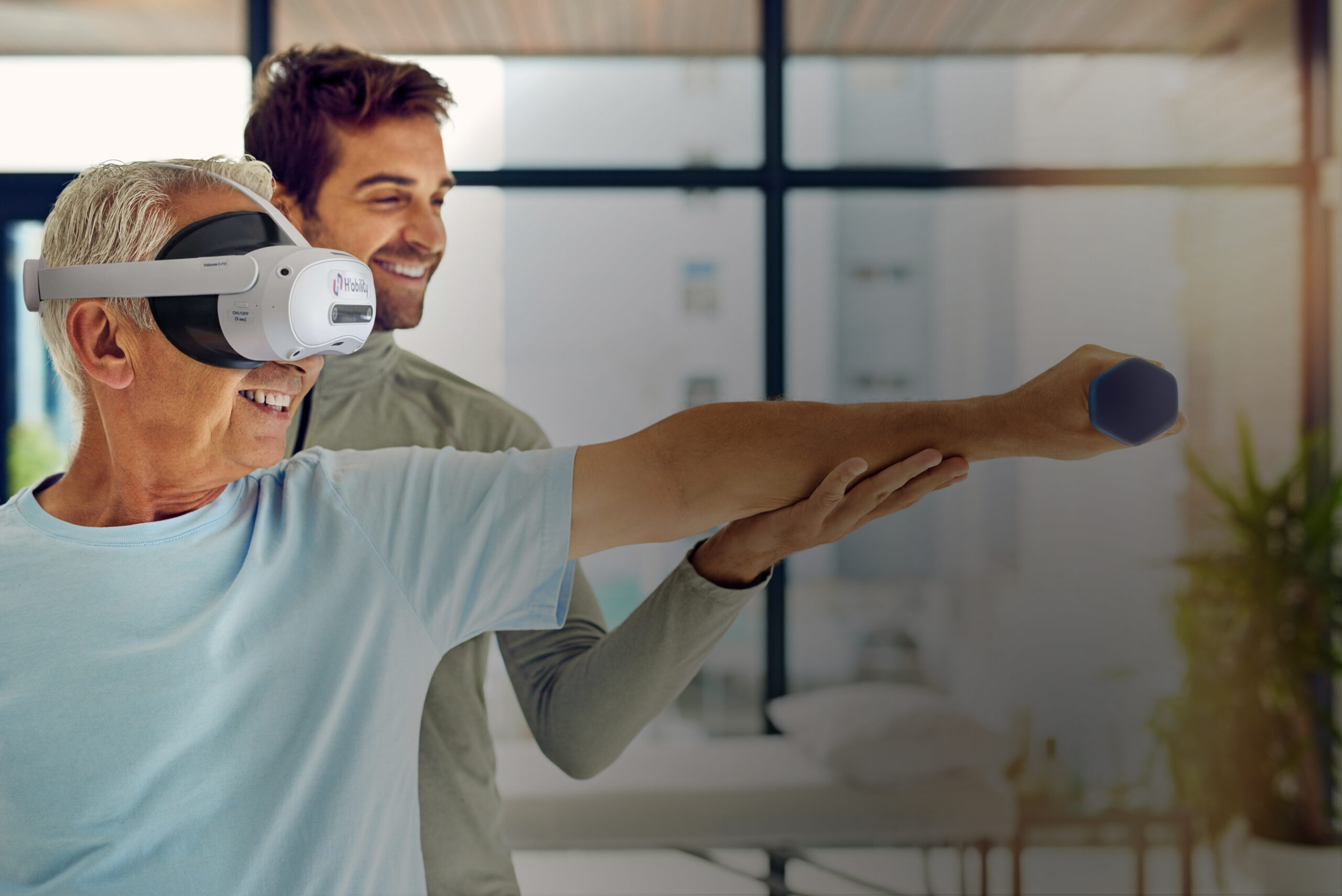
Casque réalité virtuelle personne âgée EHPAD rééducation

Clinical Studies on Virtual Reality Rehabilitation

Virtual reality has proven itself in the field of rehabilitation for more than 20 years. With this innovative technology, patients can benefit from more immersive treatments to help them recover physical and cognitive abilities.

Many studies have been conducted to evaluate the impact of VR on rehabilitation. The results are conclusive, and today virtual reality is an effective complementary approach to traditional methods.

The HAS's recommendations on virtual reality

The HAS recommends the use of virtual reality (VR) in rehabilitation for the chronic phase of stroke to stimulate neuroplasticity and improve motor recovery, by exploiting immersive and interactive exercises. She specifies that the intensity, frequency and personalization of the sessions are essential to maximize the therapeutic benefits.

Logo Haute Autorisé de Santé

Research at the heart of our developments

H’ability was developed based on clinical evidence from the scientific literature, which shows the effectiveness of gamification, immersion and positive visual feedback in reducing pain and improving rehabilitation. These elements are important pillars of virtual reality as a therapeutic tool and have contributed to the development of our device.

Through immersive virtual environments, virtual reality provides patients with a fun and effective rehabilitation experience, helping them focus on their recovery goal and improve their coordination, strength, and flexibility. This technology allows patients to work on tasks specific to their condition in a controlled virtual environment, which promotes better participation and increased motivation to achieve their rehabilitation goals .

.

The benefits

  • A patient’s motivation plays an important role in their determination and the outcome of their therapy.

“Factors influencing motivation for rehabilitation can only have positive effects on patient care.” (1)

  • Serious games increase patient engagement, allowing them to increase their exercise time.

“Prolonged endurance in training and greater improvement in some areas of motor function, as well as very high patient motivation and strong positive impressions of the treatment, suggest the positive effects of feedback treatment and its high level of patient acceptance.” (2)

“The game-based mobile VR program effectively promotes upper extremity recovery in stroke patients. In addition, patients completed two weeks of treatment using the program with no adverse effects and were generally satisfied with the program. This mobile VR play-based upper extremity rehabilitation program can replace parts of conventional therapy that are delivered individually by an occupational therapist. » (3)

“The results of the study demonstrated that immersive 3D technology can bring an increased interest/pleasure score resulting in faster and more efficient functional performance.” (4)

  • Patients who are informed of the progress of their rehabilitation see their motivation and commitment increased.

“The experience of taking ownership of the rehabilitation process made patients accountable, had a positive effect on their activity levels, and helped them cope with their challenges.” (5)

.

The use of H’ability has a positive effect on the motivation of our patients!

84% of our patients consider that they have succeeded in the exercises proposed by their therapist during the H’ability session

97% of patients want to use H’ability again

89% of healthcare professionals who have used the solution find that their patients surpass themselves and go further than using conventional rehabilitation exercises

96% of healthcare professionals find their patients more motivated when they use H’ability

Results of the DM H’ability questionnaires as of 11/05/2023

.

Sources

Virtual reality is an innovative solution to fight against kinesiophobia (the fear of injuring oneself, or of suffering any consequence of these movements such as pain) in rehabilitation. Virtual reality allows patients to focus on the objective of the experience, not on the rehabilitation context, giving them the opportunity to go further in their actions. Immersive virtual environments provide an exciting way for patients to perform movements, receive immediate feedback , and measure their progress.

.

The benefits

  • Pain management in the case of neck pain is essential and virtual reality improves its management.

“Compared to the control group, the virtual reality group showed significant benefits (p < 0.05) in headache relief and active cervical range of motion in flexion and extension. Compared to the sensorimotor group, the virtual reality group showed significant improvements in cervical extension. […] Conclusion: Virtual reality-based sensorimotor training can increase the effects of a standard rehabilitation program for patients with chronic non-traumatic neck pain, in particular the active range of extended cervical movements. » (1)

Existing moderate evidence supports VR as a beneficial non-pharmacological approach to improving pain intensity in patients with neck pain, with benefits for multimodal intervention […] (2)

  • VR also helps patients with low back pain overcome their fear of pain.

“We found that participants […] reported a greater reduction in fear of movement and a better overall impression of change compared to sham placebo and standard care after treatment. » (3)

“VR can significantly reduce pain intensity and kinesiophobia in patients with chronic low back pain after surgery and at follow-up.” (4)

.

Sources

Virtual reality helps manage pain during care by providing distraction and relaxation for patients. It is used to immerse the patient in a state of deep relaxation, educate them about their pain and treatment, and give them some control over themselves during care. VR should not replace traditional medical treatments, but can be used as an adjunct to improve the patient experience .

.

The benefits

  • VR reduces the amount of opioids prescribed.

VR significantly reduced (39%) the amount of opioids administered during painful procedures and appears to be a real distraction therapy for patients.” (1)

  • VR has an important role in reducing pain through distraction (use case: burn victims)

“Compared to standard analgesic treatment alone, the addition of VR distraction resulted in significant reductions in subjective pain ratings for worst pain intensity (20% reduction), pain unpleasantness (26% reduction), and time spent thinking about pain (37% reduction). The subjects’ age, gender, ethnicity, size of the initial burn, or duration of the therapy session did not affect the analgesic effects of VR distraction. » (2)

“In the case of burn patients, the provision of care and distraction through VR reduces the pain perceived by patients. In some cases, patients need rehabilitation in addition to care and VR has an effect on the reduction of pain but also on the range of motion after the rehabilitation session. (3)

  • Thanks to the use of 360° videos, the patient is distracted and relaxed, which reduces his fear of pain, his pain during the operation but also the fear of pain of the companions.

“Three-dimensional videos with virtual reality glasses and distraction cards including optical illusion images were effective in reducing pain associated with intramuscular injection of benzathine penicillin and increasing patient satisfaction.” (4)

  • The pain-reducing effect is maintained over several VR sessions.

“The results showed that on the first day of the study, the subjects reported significant decreases (27 to 44%) in pain ratings during virtual reality. They also reported improved affect (“fun”) during virtual reality. Improvements in analgesia and affect were maintained with repeated use of virtual reality over several therapy sessions. The maximum range of motion was not different between treatment conditions, but was significantly greater after the second treatment condition (regardless of the order of treatment). These findings suggest that immersive virtual reality is an effective non-pharmacological pain reduction technique in the pediatric burn population undergoing painful rehabilitation therapy. The magnitude of the analgesic effect is clinically significant and is maintained with repeated use. (5)

.

Sources

Virtual reality is effective in helping patients with neurological diseases such as multiple sclerosis, Parkinson’s disease, and neuropathic pain. It allows them to reduce their chronic pain. By distracting them from their pain and helping them relax, VR can improve their quality of life and psychological well-being. Studies have shown that VR can reduce anxiety and pain in patients with neurological conditions, which can be used as an adjunct to traditional medical treatments.

The French National Authority for Health (HAS) recommends the use of virtual reality in addition to conventional rehabilitation, for the recovery of motor functions after stroke.

.

The benefits

  • VR has an effect on quality of life and the reduction of depressive states in the post-stroke population.

“Applied VR therapy significantly increased the sense of self-efficacy and the level of acceptance of the disease; however, this effect was similar to that achieved with the standard intervention. […] The use of VR therapy combined with neurological rehabilitation had a positive effect on improving mood and reducing depressive symptoms in post-stroke patients. » (1)

“The conventional rehabilitation approach combined with virtual reality appears to be more effective in improving perceived health-related quality of life in stroke survivors.” (2)

  • The use of VR is recommended for upper limb motor rehabilitation in stroke patients.

“This meta-analysis showed that rehabilitation through games […] leads to better improvements, compared to conventional treatment […]. Regardless of the technological device used, greater adherence to a consolidated set of neurorehabilitation principles improves the effectiveness of serious games. Future development of stroke-specific rehabilitation interventions should take greater account of the consolidated set of neurorehabilitation principles. » (3)

“VR-supported upper extremity exercise therapy may be effective in improving motor rehabilitation outcomes. Our review showed that out of the 12 rehabilitation outcomes examined during VR-based therapy, significant improvements were detected in 2 (upper limb motor function and range of motion)” (4)

  • Using virtual reality, multiple sclerosis patients observed significant improvements in their fatigue, quality of life, and balance.

“In general, functional mobility showed a similar improvement between groups, while for fatigue, quality of life, and balance, VR promoted an equal or greater improvement than conventional exercises. The meta-analysis confirmed that for functional mobility, VR does not promote significant improvement, while for fatigue, quality of life, and balance, VR promotes superior improvement. » (5)

  • The use of virtual reality is beneficial for improving balance in patients with Parkinson’s disease.

“VR training resulted in significantly better performance compared to the conventional physiotherapy group […] 12 weeks of RV rehabilitation resulted in greater improvement in balance and gait in people with Parkinson’s disease compared to conventional physical therapy. » (6)

.

Sources

The resumption of virtual reality mirror therapy offers an innovative approach to rehabilitation. By using VR headsets, patients can have an immersive experience where they see their missing or injured limb act functionally, exactly replicating the gestures performed by the healthy limb. This approach promotes functional rehabilitation and pain reduction, offering new perspectives for mirror therapy.

.

The benefits

  • Mirror therapy promotes the activation of the motor area of the brain on the affected side in patients who have suffered a stroke.

“Bilateral mirror therapy led to greater M1 neural activities than unilateral mirror therapy and mirrorless bilateral movements in stroke patients.” (1)

  • Mirror therapy is effective in improving upper extremity motor function, motor skills, activities of daily living, and pain reduction.

“Virtual reality mirror therapy appears to have potential effects on restoring upper limb motor function in patients with chronic stroke.” (2)

“Mirror therapy moderately improved the movement of the affected upper and lower extremity and the ability to perform daily activities for people during and beyond six months after stroke. Mirror therapy reduces pain after stroke, but especially in people with complex regional pain syndrome. » (3)

.

Sources

Do you have a research project with virtual reality?

Would you like to conduct a clinical research project related to virtual reality? Do you have any questions about the clinical studies carried out? Contact us and we will be happy to discuss them with you.