


Virtual Reality: a promising ally for the rehabilitation of seniors after a fall
Falls in older adults are a major public health problem, often synonymous with loss of autonomy and quality of life (Ambrose et al., 2013). Rehabilitation sessions, which are crucial for promoting recovery, can be optimised thanks to new technologies. Among these, the virtual reality (VR) developed by H’ability is emerging as a tool that is as innovative as it is effective.
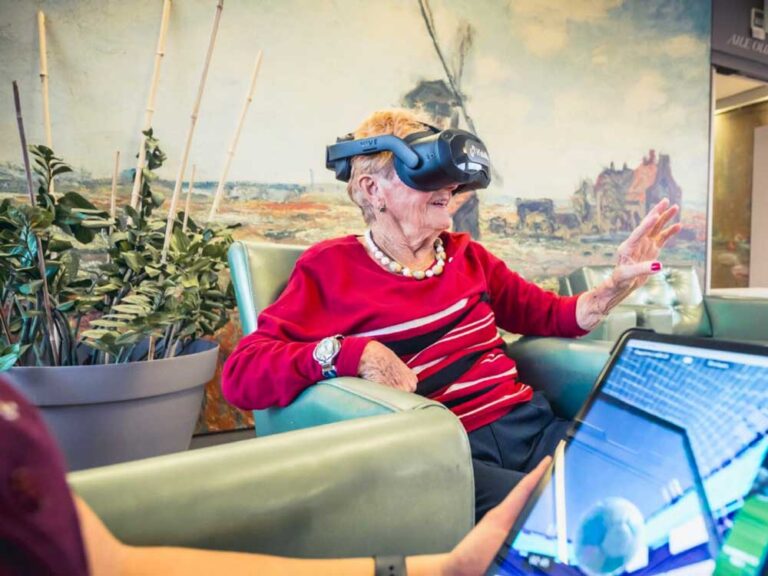
How does VR contribute to post-fall rehabilitation?
The challenges of post-fall rehabilitation
Older adults who are confronted with a traumatic event such as a fall often have to overcome not only physical injuries, but also a loss of self-confidence (Scheffer et al., 2008). It is a double punishment that can delay or even complicate the return to normal of their state of health. For example, some older people develop a fear of walking and reduce their overall amount of daily physical activity after a fall, which has the direct effect of accelerating the loss of independence.
Gently rehabilitate
This “post-fall syndrome” generally results in a fear of falling again. The posture and behaviors of the person who falls change. For example, we can observe a tendency to lean back (commonly called retro-pulsion) for fear of the emptiness in front of us.
In this context, consulting a physiotherapist after a fall is essential. Rehabilitation restores functional autonomy, balance and reduces apprehension. However, the success of this process depends on one key factor: patient engagement. Effective rehabilitation requires a motivated senior who is fully invested in his or her care pathway. So to speak: no successful rehabilitation without a specific patient!
The H’ability solution is to offer patients stimulating, immersive and motivating environments to encourage or even help patients to enjoy their rehabilitation sessions. According to the study by Laver et al. (2017), virtual reality also helps to regain self-confidence. Indeed, virtual environments would allow patients to train in simulated situations resembling real life, without fear of the risks associated with falling.
Proven effectiveness of virtual reality games
In less than a decade, several studies have highlighted the potential of virtual reality devices for rehabilitation. A systematic review by Bonnechère et al. (2016) points out that some VR games can improve muscle strength, balance, and functional autonomy, as well as being particularly beneficial for older populations. Similarly, Mirelman et al. (2011) observed a significant improvement in balance in older adults using VR as an adjunct to traditional rehabilitation.
At H’ability, we have developed more than forty games to personalize your sessions according to the specific pathologies of your patients. Ask us for a demo.
References:
- Ambrose AF, Paul G, Hausdorff JM. Risk factors for falls among older adults: a review of the literature. Maturitas. 2013; 75(1):51-61.
- Scheffer AC, Schuurmans MJ, van Dijk N, van der Hooft T, de Rooij SE. Fear of falling: measurement strategy, prevalence, risk factors and consequences among older persons. Age Ageing. 2008; 37(1):19-24.
- Laver K, George S, Thomas S, Deutsch JE, Crotty M. Cochrane Review: Virtual reality for stroke rehabilitation. Eur J Phys Rehabil Med. 2017; 53(3):590-591.
- Bonnechère B, Jansen B, Omelina L, Van Sint Jan S. The use of commercial video games in rehabilitation: a systematic review. Int J Rehabil Res. 2016; 39(4):277-290.
- Mirelman A, Maidan I, Herman T, Deutsch JE, Giladi N, Hausdorff JM. Virtual reality for gait training: can it induce motor learning to enhance complex walking and reduce fall risk in patients with Parkinson’s disease? J Gerontol A Biol Sci Med Sci. 2011; 66A(2):234-240.