


Interview with Baptiste, occupational therapist
to the Capuchins
How did you get into the profession of occupational therapist?
Baptiste Mourant, occupational therapist: I have always wanted to work in the paramedical field! At first, I was attracted to orthoptics, which is the rehabilitation of visual function. Then I had the opportunity to do an internship in occupational therapy and then I realized that I liked it a lot.
I must have been doing this job for 7 and a half years now. Yes… it goes by quickly! (laughs). After my studies in Paris, I had the chance to join Les Capucins directly and I haven’t left.
What is your daily life like in a rehabilitation center?
I work in rehabilitation in a day hospital. Patients come for care during the day, then go home in the evening. My role is to support them towards more autonomy in their daily lives. I start from their occupational difficulties to build a personalized rehabilitation program. Sometimes, rehabilitation alone is not enough. In these cases, I also intervene on the environment: this can involve assessments of the need for technical aids, housing, workstation, driving position or the manufacture of orthotics.
How did you discover that virtual reality could help you in your practice?
I had already tried virtual reality (VR), but only in a personal context. I didn’t necessarily imagine it as a therapeutic tool. It was when I discovered H’ability that I realized how much VR could have a real place in functional rehabilitation.
We tested the solution at Les Capucins and we were quickly convinced of its interest. We found the tool intuitive, easy to use, whether to launch a session or program exercises. The exchanges with the H’ability team are fluid and we know that they are there if we need anything.
Today, H’ability has been an integral part of our rehabilitation tools for several years. There are two devices available in the establishment, mainly used by occupational therapists in adult rehabilitation. It has become a tool in its own right, naturally integrated into our practices, in the same way as any other therapeutic medium. We even chose to leave the headsets directly on the occupational therapy technical platform, to be able to access them easily. It must be said that we use them almost all day long (laughs).
There are exercises that I simply couldn’t offer patients without virtual reality. So what I do with the headset is precisely what would be difficult to set up otherwise with such a level of immersion and engagement.
How do you integrate H’ability into your sessions?
As an occupational therapist, I use the H’ability solution to help my patients improve their abilities to resume everyday gestures. I use it during my sessions to work on daily activities in adapted immersive environments, such as the supermarket, the vegetable garden, the music room or the canteen.
Often, I integrate a VR session during the session. I program 3 or 4 exercises, varying the types of movements or their intensity. For example, after an exercise that mobilizes the upper limbs in significant amplitudes, I propose a sequence of more repetitive gestures with less amplitudes.
Since we can make an exercise evolve live, whether in terms of intensity or range of motion, we can modulate according to the patient’s feelings so that the exercise remains relevant and that there is no pain.
At the end of the session, I discuss with the patient how he or she feels. Sometimes I show them the data from the tablet or even film them in full motion so that they realize the progress they have made. It’s a very good motivational lever.
Then, I make sure that the acquired skills are transferable to real life at home. We repeat the same gestures… without the helmet this time.
Who are these patients you support?
I work with adults with a wide variety of pathologies. Many have neurological disorders: stroke, tetraparesis, brachial plexus, neurodegenerative diseases such as Parkinson’s, etc. I also accompany chronic pain patients, with low back pain or MSDs, for example.
The length of the follow-up really depends on each situation. For some, it’s quite short, a month, a month and a half, especially in cases of chronic pain such as low back pain. For others, it can be much longer. For example, for a patient who has just finished a stroke, we are in an intensive rehabilitation phase that can last three, four, or even five months. So it’s a diversified job, both in terms of patient profiles, follow-up times, and the approaches used. We support patients on what makes sense for them in their daily lives.
How are these virtual reality sessions received by your patients?
First of all, there is a lot of curiosity. Most patients have never tried virtual reality, let alone in a therapeutic setting. And then, very quickly, they become demanders!
The most surprising thing is that they don’t always realize their progress. Caught up in the immersive universe, focused on the exercise or the game, they forget the execution of the movement as such when in reality, they can sometimes go further than they thought they could do.
So for me it’s really a unique solution that has helped me maintain a good level of motivation in my patients.
Do you see an impact on their motivation?
Yes, absolutely! When you start a session, their goal is not necessarily to succeed in the movement itself, but simply to play, to do the exercise. It is this playful side that gets them on board.
Beyond the benefits on the functional aspect, there is a real playful dimension. For patients who have been in rehabilitation for a long time and who are starting to get tired of classic exercises, the helmet brings a new breath of fresh air. This is a significant motivational lever. However, it is necessary to succeed in making the link with the interest of carrying out the activity to achieve a gain in autonomy on a daily basis.
It is also particularly useful with patients who have kinesiophobia, i.e. a fear of moving because of pain. I think of some who keep their elbows glued to the body, for fear of triggering pain… and with VR, we see them going further, moving more freely, without even realizing it. It’s very encouraging.
What makes you get up in the morning?
What motivates me is to see patients progress. They arrive with specific difficulties, which prevent them from doing what they like or need. And little by little, they regain their abilities, they regain confidence. It’s extremely rewarding.
I’m thinking, for example, of a post-stroke patient, who kept his arm wrapped around his body. He couldn’t take it off, it was causing him too much pain. And one day, in the middle of a session with the helmet, he managed to raise his arm behind his head! He didn’t even realize it at the time. But the progress was there: more amplitude, more fluidity… It was very impressive, for him and for me.
So I would say that participating and witnessing these advances is really what drives me. Patients in these phases of progression are often very enthusiastic. We share a lot of positive things, moments rich in emotions.
Of course, it’s not always linear, but the work atmosphere remains very stimulating, focused on well-being. It’s all this that gives meaning to my job, and makes me get up every day with desire.
Thank you Baptiste!
🏥 About the Centre Les Capucins
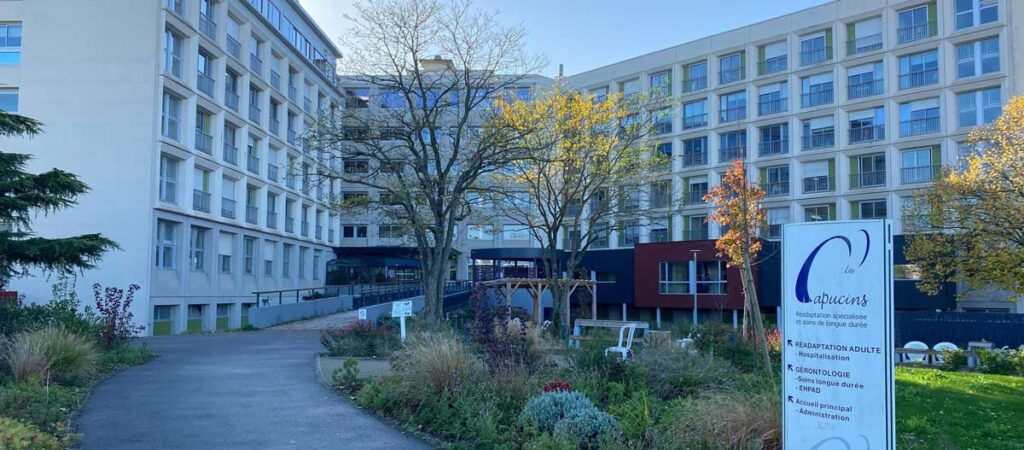
Image: Capuchin Center
Located in Angers, the Centre Les Capucins is a private health establishment of collective interest specialising in medical care and rehabilitation. It welcomes children, adults and dependent elderly people, with personalised care in full hospitalisation, day or week. The establishment is distinguished by its highly equipped technical rehabilitation platform, mobilizing a multidisciplinary team of more than 450 professionals (doctors, occupational therapists, physiotherapists, psychologists, speech therapists, etc.). It also offers specific care in Long-Term Care (LTC) and nursing homes, as well as a unit dedicated to patients in a chronic vegetative or pauci-relational state.
Don’t miss any next news: