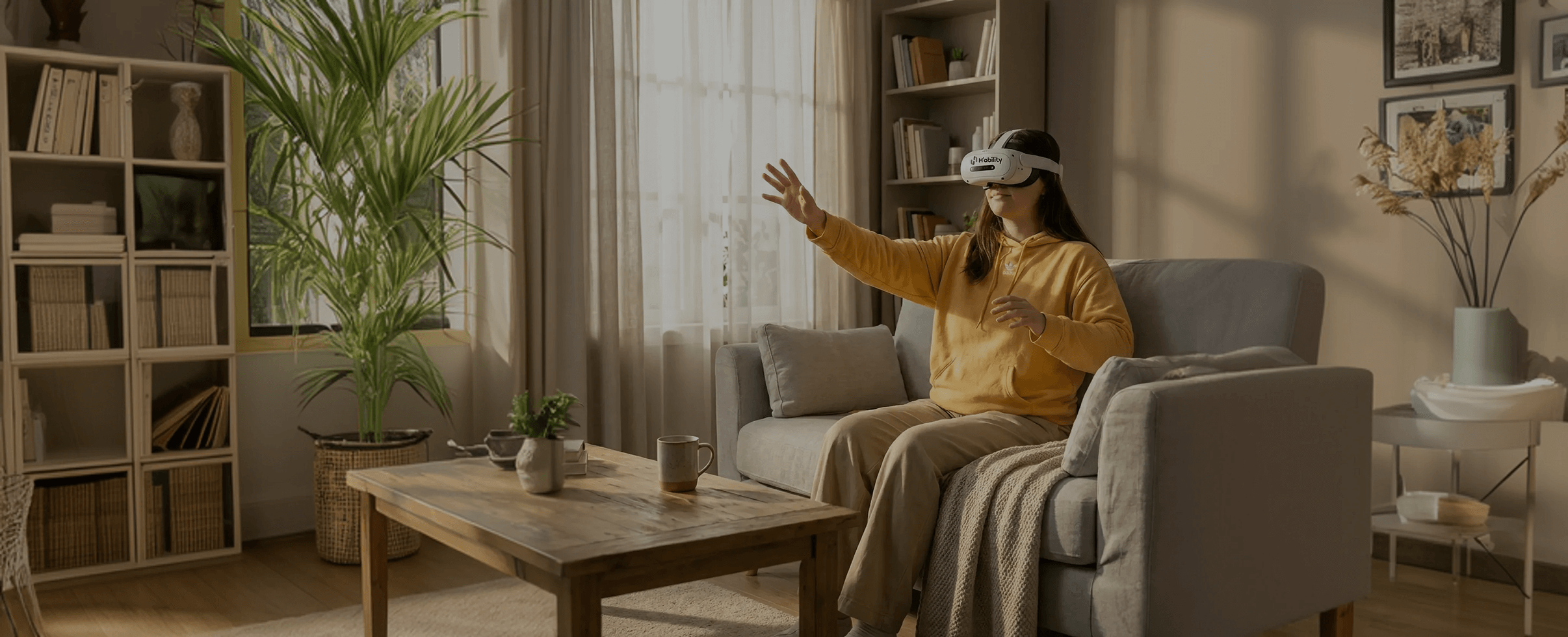
Post-stroke journey: the disruption of the return home and the solutions
Every year in France, stroke affects about 150,000 people and is the leading cause of acquired disability in adults. While…


Occupational therapist at the LADAPT in Aube, Ninon sharesher experience with the H’ability virtual reality headset. From vocational rehabilitation to the training of caregivers in nursing homes, she tells us about her use of the system.
Ninon: The LADAPT de l’Aube is a specific establishment to promote the social and professional reintegration of people with disabilities. These are people who are referred to us by the MDPH following recognition as disabled workers. For example, these are people who have suffered a disabling chronic illness or an accident at work that has resulted in incapacity for the job and requires professional reorientation.
It is above all to allow them access to return to work. This involves the layout of their workstation with precise indications both on posture and on the organizational level. Therapeutic part-time work or the need to go through written and pictorial instructions, for example in cases of cognitive disability.
It could really be used for reconditioning, for effort and also for evaluation. For example, many people are reorienting themselves towards packaging, preparation or boxing positions, which require quite significant amplitudes and physical stresses. The virtual reality headset would then represent a real therapeutic tool to allow this re-training, whether it is effort or cognitive, in order to facilitate professional activity.
Yes, in addition to my current position, I carry out temporary contracts with the Nancy School of Occupational Therapy. I accompany the third years, i.e. future graduates, as part of tutorials on the role of the occupational therapist in nursing homes.
It was in this context that I presented them with the H’ability helmet. They were put in an ecological situation, really putting themselves in the patients’ shoes. This is how we get the best look to set up our intervention project.
Some who had already seen him during an internship immediately had the therapeutic gaze, the objective gaze of ecological situation. They immediately perceived the aspect of adaptation of the sessions that is possible. It was quite interesting because I took the opportunity for them to introduce him to the rest of the group.
Those who discovered VR for the first time in my class had more of this playful enthusiasm, with a lot of curiosity and a little wonder at the technology that H’ability offered. I could hear phrases like, “Oh, can we really do this in occupational therapy?” or “Woah, the quality of the image is amazing! In addition, you can interact with the environment,” in reference to games such as the vegetable garden for example where you can give the apple to the pony.
VR is recommended at the beginning of the loss of autonomy to help GIR 4-5 residents who arrive at the nursing home to maintain this autonomy. These are the target people for the use of the device because their cognitive and motor abilities begin to decline. VR is not recommended for people with behavioral disorders as is the case in Alzheimer’s and related diseases.
I would say the other main application is fall prevention.
We are immersed in a bathroom or living room, and we need to identify what could be a fall hazard. This really allows this identification in an ecological situation. We put people in a position to spot dangers in a virtual environment that resembles their daily lives.
👉 In the exercise of the market, there is a cognitive solicitation with a shopping list to memorize, but also a motor solicitation since it is necessary to move around to collect the items. It is this cognitive and physical combination that makes the exercise so rich.
This is one of the major benefits I have observed. As a reminder, kinesiophobia is the fear of movement often present in patients after an accident or a pathology. With H’ability, the person can perform movements in a secure environment. It is often a source of wonder for them to realize that they have succeeded in a gesture, and without having been in pain, without them realizing it during the exercise.
Then you have to transfer what you have learned. It takes several sessions, but I was indeed able to observe the outcome. Patients are gradually managing to reproduce the movements and behaviours worked on in virtual reality in their daily lives.
It’s very impressive. The technology really replicates the environment around us through very accurate cameras. You can see all the movements very well, you can even make out the facial expressions of the people present.
The interest I see in it is above all to promote adherence, therapeutic adherence to the virtual reality headset, among people who would be rather reluctant.
The H’ability technology is really very well designed in the sense that it will not overstimulate the vestibular system. We are therefore less confronted with all the limitations of VR that can cause a feeling of motion sickness, dizziness or nausea.
This is something you really don’t encounter with H’ability, but it’s the fear of anyone using virtual reality for the first time. So I think that being in mixed reality can have this reassuring side.
The more real-life the H’ability exercises are, the more relevant they will be. The more they will engage the person’s occupational commitment.
For example, in the vegetable garden, we have the tree in front of us and from which we can pick an apple and give it to the pony. It’s not just an analytical activity, it’s not cones that we’re going to pile on sticks. It has a meaning, a purpose, a context.
What is also very appreciable with H’ability are all the ability to modulate and adapt activities. The system can adapt to the patient’s initial abilities and also to the abilities that will improve, we hope, with rehabilitation. As an occupational therapist, we intervene a lot on the architectural and material environment of patients. The fact that it’s entirely adaptable allows us to transpose the knowledge we have learned from the virtual world to the real world.
Whether it’s for people with a loss of autonomy at home or for people coming out of rehabilitation, I find it a real challenge and interest. Both in rehabilitation centres and outside, in home services.
We are often a little limited in terms of means because we are not going to carry the entire occupational therapy room in the trunk of the car, whereas the virtual reality headset is very compact and does not require any connection or special arrangement. That’s really where I think he has his place to play.
Yes, I am convinced of its relevance. In HAD alone, in home hospitalization, when leaving a rehabilitation center to maintain what has been learned: we notice that there is often a break in the care pathway.
The person returns home, regains their habits, also regains their everyday roles, their role as a parent, they return to work. We then notice that there is necessarily a decrease in the interest in maintaining the skills recovered in a rehabilitation centre.
Generally, there is not necessarily a HAD that is set up afterwards, and when it does, the tools are less. This is where H’ability would provide an appropriate response.
Every year in France, stroke affects about 150,000 people and is the leading cause of acquired disability in adults. While…
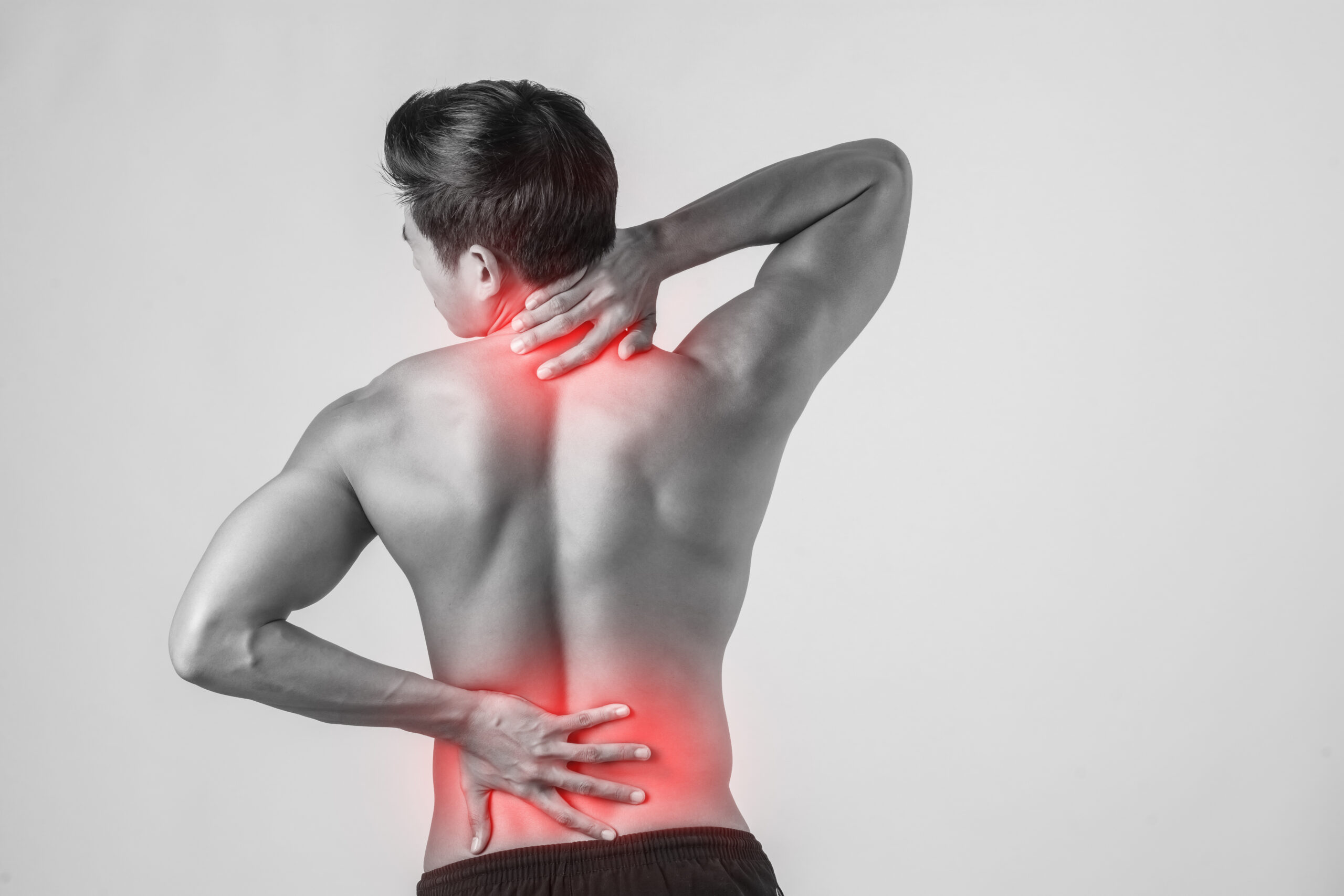
Chronic low back pain is one of the main reasons for physiotherapy consultation and one of the leading causes of…
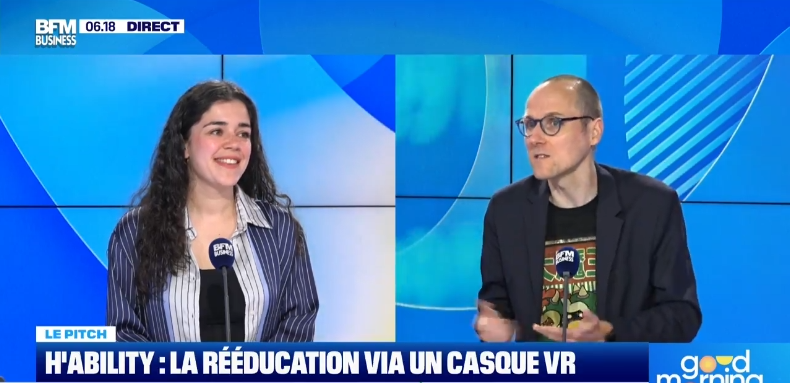
H’ability on BFM Business: virtual reality at the service of rehabilitation On May 12, 2026, H’ability was the guest of…
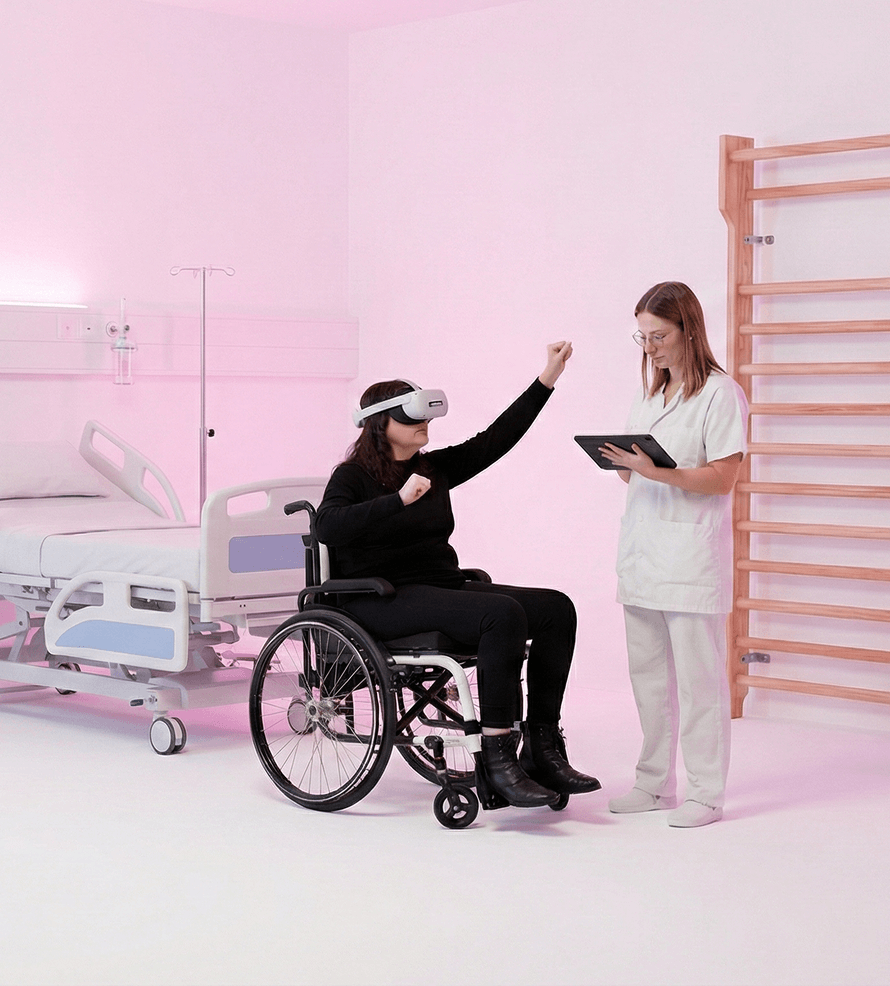
The career of Blandine Le Mené, a private occupational therapist, and her use of virtual reality How can virtual reality…