Post-stroke journey: the disruption of the return home and the solutions
Every year in France, stroke affects about 150,000 people and is the leading cause of acquired disability in adults. While…


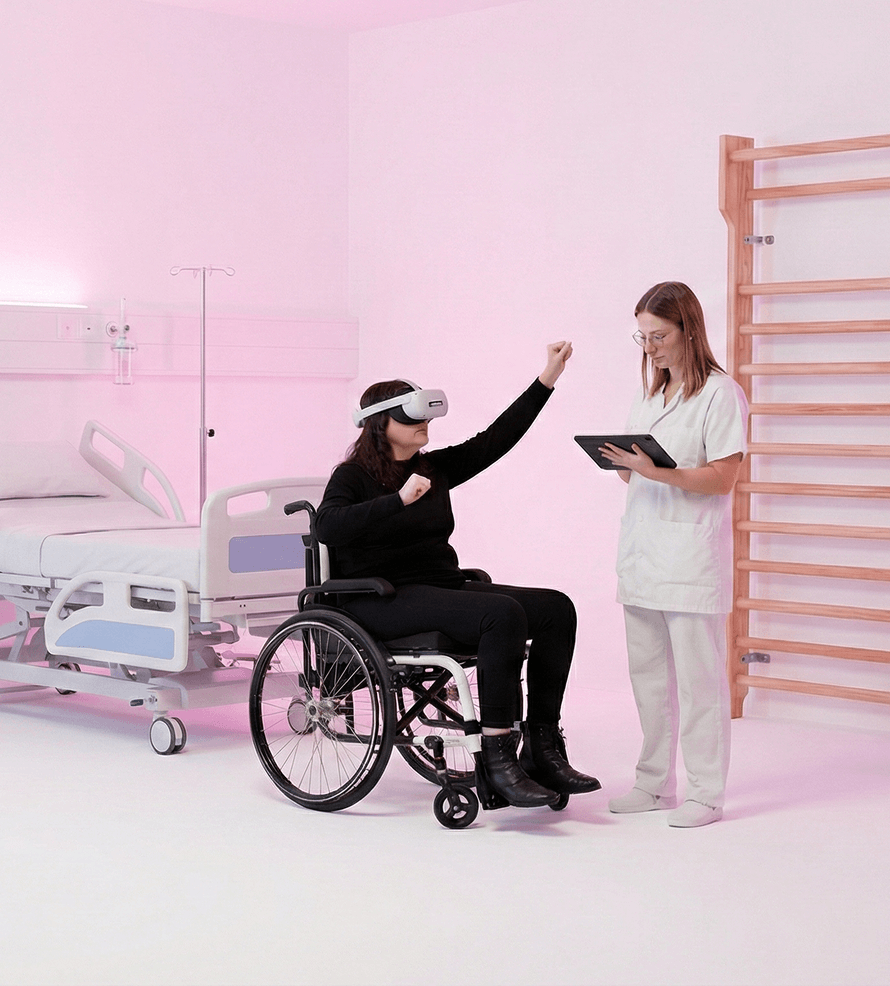
Since its creation, H’ability has been committed to offering innovative solutions that make rehabilitation more effective, more motivating and more accessible. After having seduced health professionals thanks to its exercises dedicated to the upper limbs, our system is now expanding its field of action with the rehabilitation of the lower limbs.
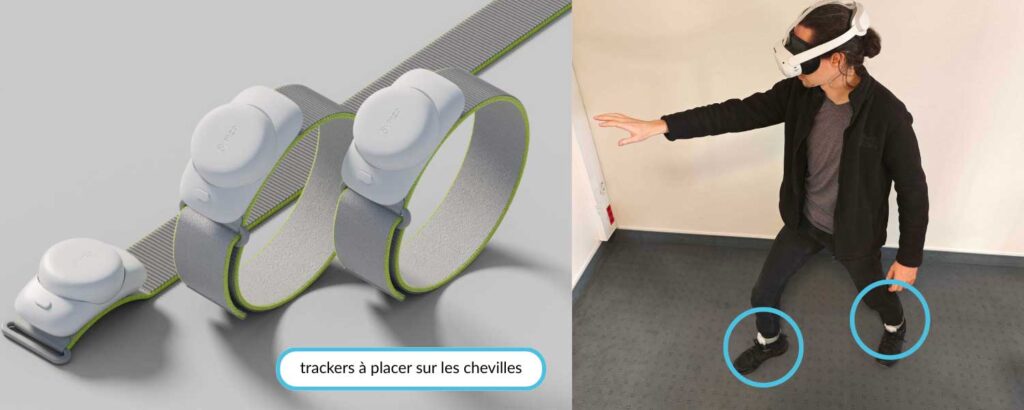
This breakthrough was made possible by the integration of the Pico 4 headset and ankle-positioned trackers that track leg movements. Connected to the headset, these sensors analyze the kinematics of the movement in real time, without the need for bulky equipment or external cameras.
🎯 One tool, many indications: fall prevention, motor rehabilitation, proprioception work, coordination and dual tasking.
Precise monitoring of the lower body makes it possible to address a variety of clinical cases, whether it is balance disorders, stroke follow-up, post-operative rehabilitation or motor deconditioning.
Trackers positioned on the ankles make it possible to analyse the overall coordination of movement (arms, legs, feet, etc.) and physiotherapists and occupational therapists can thus combine proprioception work, inter-limb coordination and dual tasks (cognitive and motor) in the same exercise, without multiplying the tools.
Motivation remains one of the biggest challenges in rehabilitation. Thanks to gamification, the patient immerses himself in a stimulating environment, visualizes his progress and rediscovers the taste for effort. The scores obtained after each fun exercise promote the patient’s regularity and encourage him to surpass himself. With the integration of the lower limbs, the immersion is even more total for the patient who can move through the universe.
Mixed reality offers the patient the possibility of moving around in an immersive universe while remaining in a secure environment. This sense of control helps reduce kinesiophobia (fear of movement related to pain or falling) and helps the patient regain confidence in their daily actions. A patient in pain in post-operative rehabilitation, for example, will be able to concentrate not on the pain but on the movement and the pleasure of “playing”.
"With mixed reality, the patient remains in his or her usual environment (he or she sees his or her body, the room, the real landmarks, etc.) while benefiting from an enriched working environment."
– Frank Wein, sports and knee surgeon
The lower limbs are essential for mobility, balance and independence. Their rehabilitation is used in many clinical contexts, and virtual reality brings real added value to many treatments.
To get you a concrete idea, our team will come directly to your structure for a demonstration session.
Would you like to discover our new modules or contribute to their development?
Every year in France, stroke affects about 150,000 people and is the leading cause of acquired disability in adults. While…
Chronic low back pain is one of the main reasons for physiotherapy consultation and one of the leading causes of…
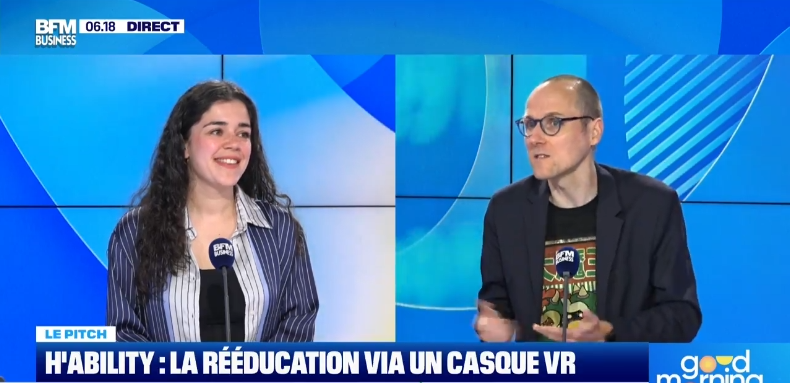
H’ability on BFM Business: virtual reality at the service of rehabilitation On May 12, 2026, H’ability was the guest of…
The career of Blandine Le Mené, a private occupational therapist, and her use of virtual reality How can virtual reality…