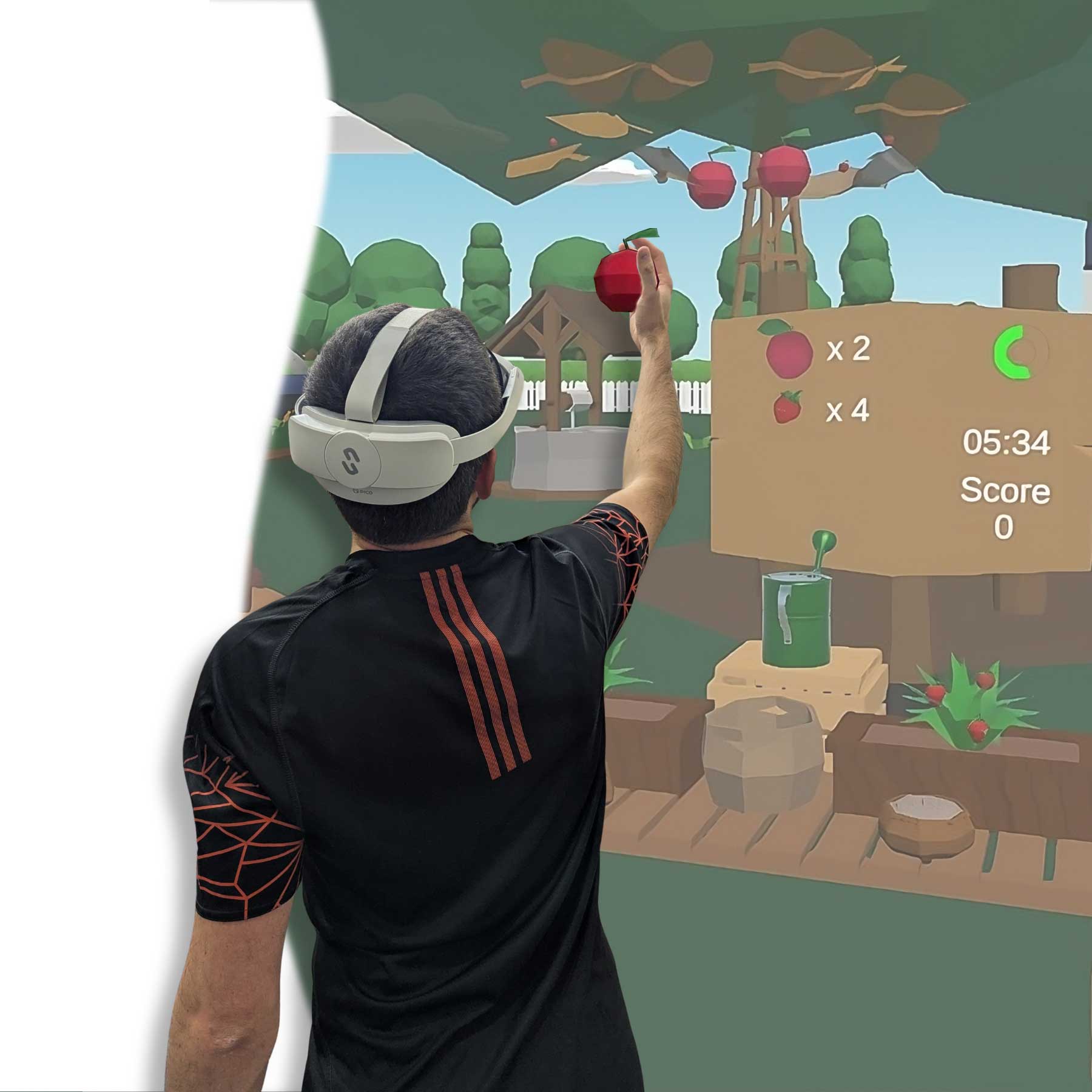
Post-stroke rehabilitation at home: H’ability in France 2030
H’ability is taking a new step in its commitment to ageing well. Through the H’ability Home project, the company is…


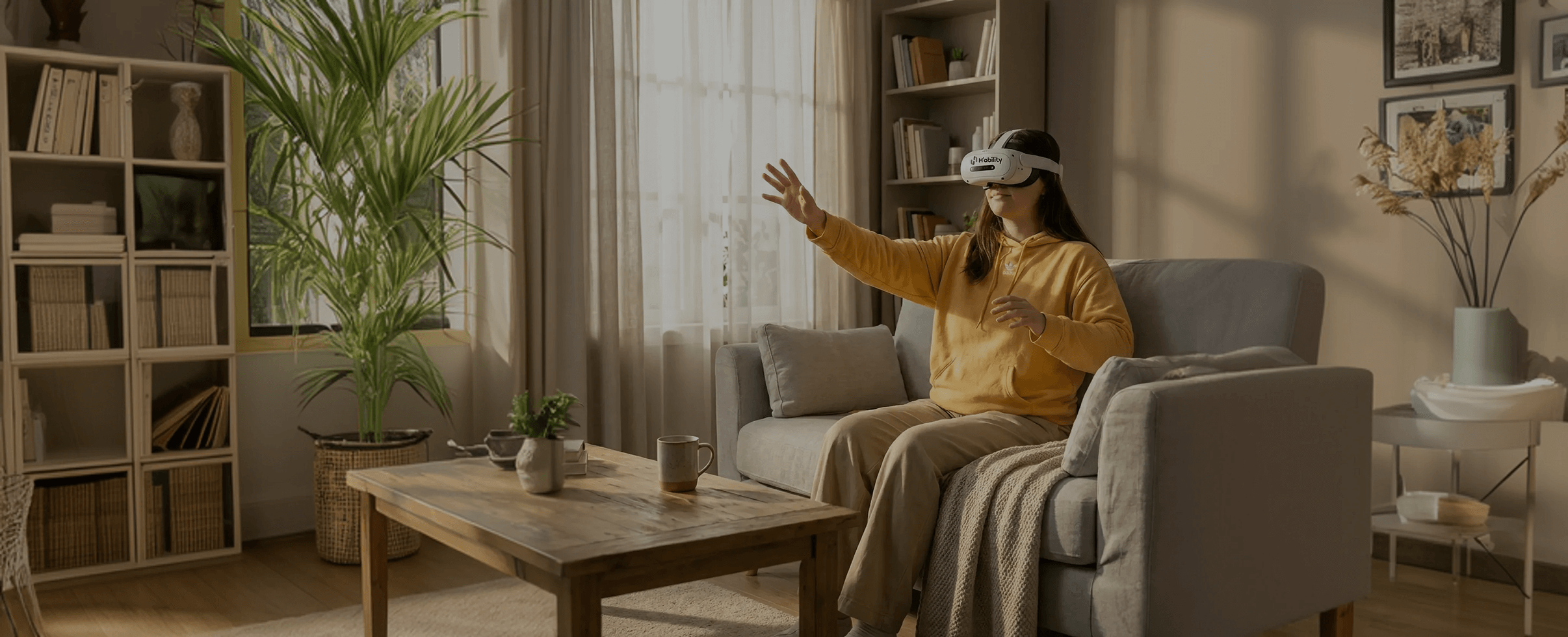
Virtual reality (VR) has emerged in recent years as a promising technology in the field of rehabilitation because it allows the patient to be motivated, to diversify exercises and to reduce kinesiophobia. VR is developing to be more accessible by being portable, without cables or sensors, and by integrating hand tracking technology, allowing natural interactions.
Mixed reality (MR), a technology that combines the real and the virtual, makes it possible to go even further in terms of accessibility.
XR (eXtented Reality) brings together VR, AR and MR. We can conceive of a continuum between:
Augmented reality (AR): the real world is perceived, but digital objects (annotations, holograms, landmarks) are superimposed on it that we see above reality but that have no interaction with the world around us.
Mixed Reality (MR): a fusion of the real and virtual worlds, with interactions between digital objects and the physical world.
Virtual Reality (VR): a fully simulated world, in which you are immersed and cut off from the real world.
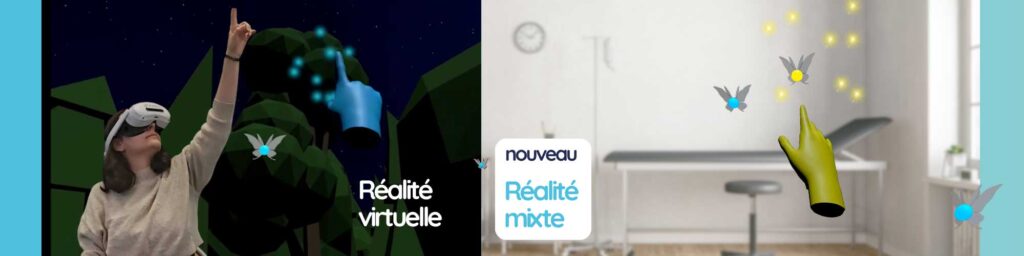
MR allows us to integrate virtual objects or elements into our real field of vision, so that they coexist with the physical world and can interact with it: for example, it is possible to make a virtual basketball appear, which the patient can catch, manipulate, throw and the ball will have all the expected interactions such as bouncing on the surfaces it touches.
MR does not suppress the physical reality around the patient: it enriches it, completes it. This reduces the perceived breaking effect and facilitates anchoring in the known environment.
Let’s remember what virtual reality has already demonstrated in rehabilitation, as well as the obstacles it encounters.
Studies show that VR can:
Promote patient engagement and motivation, by making the exercises more fun and immersive.
Divert the patient’s attention from their impairment to the experience, making the effort less focused on pain or discomfort.
To offer adaptive tasks, adjustable in difficulty, with real-time feedback, which makes it possible to individualize rehabilitation.
Offer monitoring and data collection (kinematics, temporality, etc.) to adjust the protocol.
Despite all these benefits, several obstacles remain to be overcome:
Some patients are reluctant to “enter VR”: fear of the headset, fear of cutting themselves off from reality, discomfort (nausea, motion sickness)
For some, prolonged VR sessions can lead to eye strain, nausea, or perceptual discomfort.
For patients with balance disorders or the risk of falling, total immersion can represent a danger if they no longer perceive their real environment.
Mixed reality complements what already exists in VR with the particularity of maintaining the link with the physical world while adding virtual interactive elements. This has advantages in the case of rehabilitation:
Patients stay in the environment they know, they continue to see their body, their environment, which reassures and maintains a sensory reference.
Tasks can involve physical objects (e.g. ramp, obstacles) mixed with virtual elements which facilitates transfer to the real world.
For anxious patients, MR can also be a new way of working, maintaining the environment that the patient was creating can be reassuring.
Guides, landmarks, or visual aids can be layered in the context of a room, making the exercise more intuitive.
At H’ability, we are convinced that this technology will allow more patients to have access to motivating and safe rehabilitation. Mixed reality is the ideal technology for patients who are anxious or need to work on movement, our first developments for this technology concern gait rehabilitation.
If these challenges concern and interest you, we co-develop all our applications with our users, contact us for a demonstration of the device!
H’ability is taking a new step in its commitment to ageing well. Through the H’ability Home project, the company is…
Falls are the leading cause of accidental death among people over the age of 65. Beyond the physical trauma, it…
This is another important step for H’ability: home rehabilitation finally becomes a reality with the official launch of H’ability Home.…
Every year in France, stroke affects about 150,000 people and is the leading cause of acquired disability in adults. While…