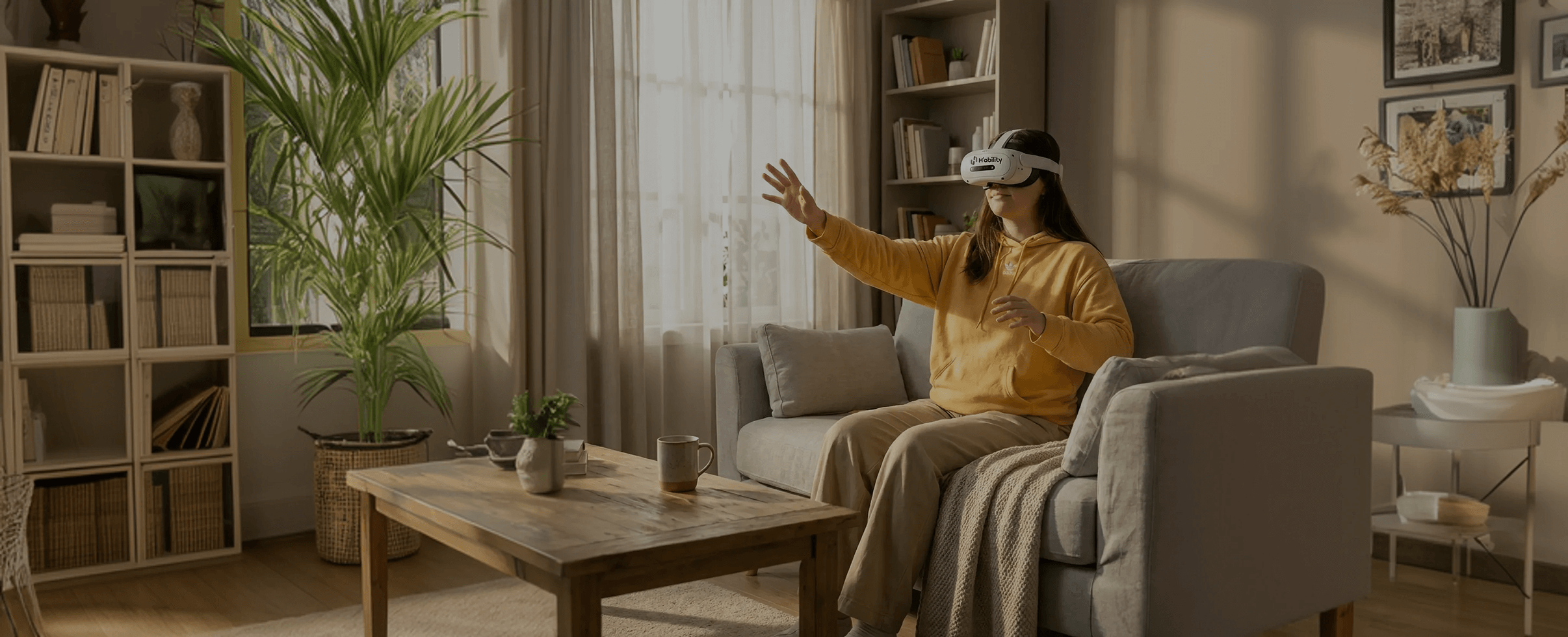
Post-stroke journey: the disruption of the return home and the solutions
Every year in France, stroke affects about 150,000 people and is the leading cause of acquired disability in adults. While…


Falls affect 28 to 35% of people over 65 years old. Their consequences are serious: fractures, loss of autonomy, psycho-emotional disorders. In addition, kinesiophobia and fear of falling hinder rehabilitation in 61% of hip surgery patients.
In 2016, a systematic review by Bonnechère et al. already highlighted that some VR games could improve muscle strength, balance and functional autonomy.
Between January and June 2025, Charles Beauclair, a Master’s student in physiotherapy at the Haute École Robert Schuman (Belgium), conducted a randomized controlled study in Luxembourg. The aim of this study was to specifically evaluate, in this context, the contribution of immersive virtual reality in post-femur fracture rehabilitation.
The trial was conducted at the Steinfort Hospital (Luxembourg) on 28 participants with an average age of 83.7 years, randomized into two homogeneous groups. These patients joined the hospital following a fall that led to a fracture of the neck of the femur. In addition, all of them benefited from standard initial rehabilitation: 8 physiotherapy sessions/week (30 min), 30 minutes of complementary activities, daily occupational therapy, group sessions and occasional interventions (psychologists, speech therapists).
In addition to their conventional rehabilitation, the experimental group benefited from immersive virtual reality sessions. These lasted 15 minutes, 5 times a week, over 4 weeks. These patients performed exercises in a sitting and then standing position. Thus the difficulty was gradually adjusted by the practitioner, also on the amplitudes, the speed of the movements, the instability of the ground or the lateral movements. The control group observed a fixed landscape via the virtual reality device (less nice, we grant you!).
The TSK scale is used to measure kinesiophobia. In this study, she shows a significant improvement within the experimental group. Indeed, the median has risen from 40.5 to 33 points. Conversely, that of the control group stagnated from 41 to 43 points. Therefore, all the data analyzed coincide in favor of the effectiveness of VR on kinesiophobia.
The fear of falling decreased more markedly in the Experimental Group. This has fallen from 34.5 to 23 points. In comparison, the Control Group saw only a modest drop from 30 to 28.5 points. Nevertheless, this tendency is not sufficient to conclude that there is a differential effect because of its lack of significance.
For the balance and gait tests, both groups progressed similarly. No significant differences were observed. For example, for the dynamic Tinetti, the median has increased from 18 to 23 points for the Experimental Group. At the same time, the Control Group increased from 18 to 21 points.
To explain this trend, a ceiling effect is suspected. Indeed, the scores were close to the maximum for this population. In addition, conventional rehabilitation, even supplemented by VR exercises, cannot replace specific locomotor training.
Notably, in highly kinesiophobic patients, VR could have an indirect effect on walking by reducing fear and facilitating engagement in rehabilitation.
In this study, the headset used was the HTC Focus 3, whose technical capabilities limited the exercises to upper limb rehabilitation. However, the arrival of new-generation headsets, such as the Pico 4 Enterprise (now integrated into the H’ability solution), opens up new perspectives. These devices now make it possible to work and monitor the evolution of the lower limbs in the context of targeted or combined exercises.
In an approach aimed at assessing the impact of virtual reality on walking and the risk of falling, these technological developments are new possibilities for intervention whose clinical benefits now deserve to be explored and objectified in future research work.
Mixed reality allows virtual elements to be superimposed on the patient’s real environment. This allows patients to interact with them safely. This technology has been used to design specific exercises dedicated to fall prevention.
The patient thus evolves in a familiar and reassuring environment, while being confronted with virtual situations likely to cause an imbalance (obstacles, unexpected events, visual solicitations). This way to see a mixed reality exercise in action.
From this perspective, we can reasonably put forward a hypothesis. Combining the effectiveness of VR on psychological factors (confidence, commitment, reduction of kinesiophobia) with specific exercises on the lower limbs in mixed reality could remove the absence of a differential effect observed. In practice, this could have a positive impact on dynamic balance and walking, contrary to the results of this first study.
Read the clinical study to discover Charles Beauclair’s work in full.
Would you like to follow the future results of our H’ability Home clinical study?
Every year in France, stroke affects about 150,000 people and is the leading cause of acquired disability in adults. While…
Chronic low back pain is one of the main reasons for physiotherapy consultation and one of the leading causes of…

H’ability on BFM Business: virtual reality at the service of rehabilitation On May 12, 2026, H’ability was the guest of…
The career of Blandine Le Mené, a private occupational therapist, and her use of virtual reality How can virtual reality…