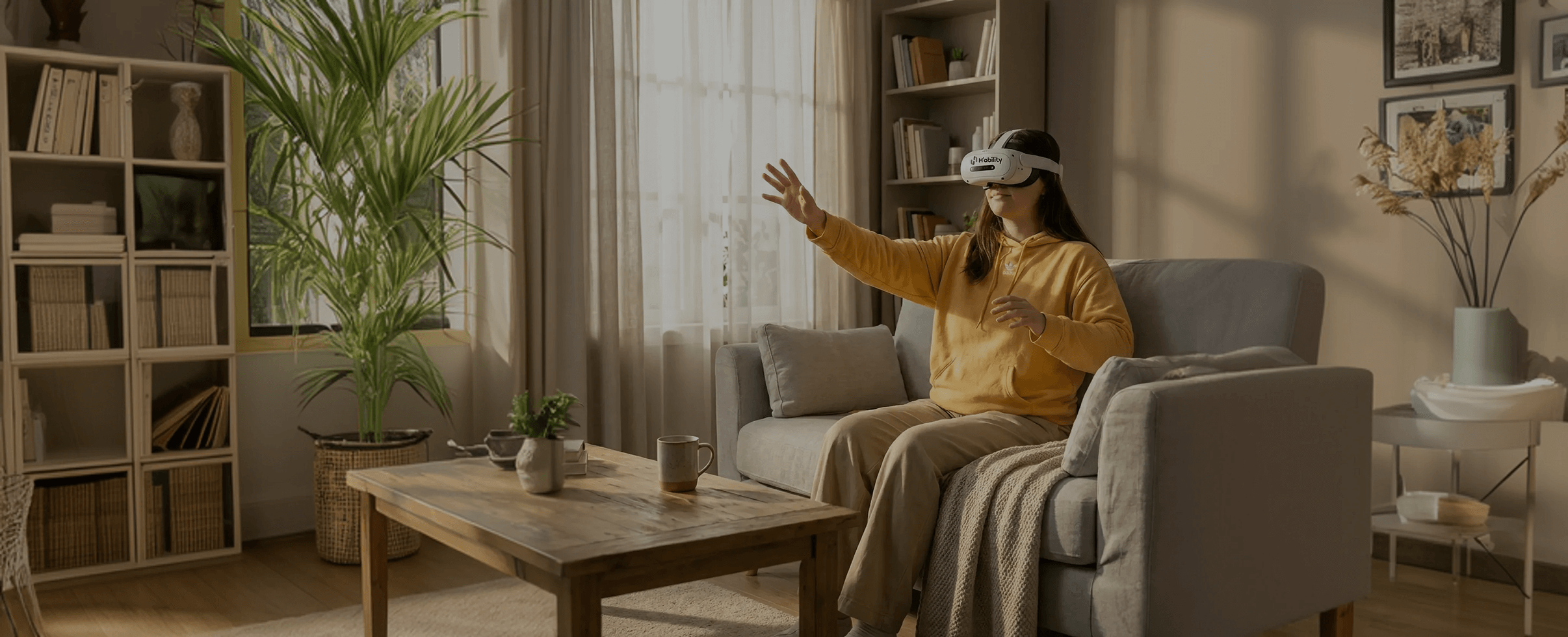
Post-stroke journey: the disruption of the return home and the solutions
Every year in France, stroke affects about 150,000 people and is the leading cause of acquired disability in adults. While…


How can virtual reality in occupational therapy transform private practice practice? Blandine Le Mené, a self-employed occupational therapist, shares her experience with the H’ability helmet. From neurology rehabilitation to chronic pain treatment and mirror therapy, she tells us how she integrates virtual reality into her daily practice.
Blandine: Originally, it was mainly for neurology and chronic pain patients. And then I extrapolated a little, especially with mirror therapy, for example for complex regional pain syndrome in hand surgery.
What pushed me to look for a virtual reality tool was above all to have a tool that was innovative and motivating enough to stimulate patients who, for example, have difficulty integrating their upper limb into an activity, either through negligence or for other motor and sensory difficulties. And then also for patients who are afraid to go outside.
It can be a transition tool between the virtual environment, which allows them to be in a safe place with the therapist, and then gradually move to mixed reality to go into their own environment.
I have also found a real benefit for patients with complex regional pain syndrome, especially with the use of mirror therapy which has been very successful. And then there’s a lot of evidence on these topics, so I base a lot on that.
What I missed was having an environment where the patient is really focused on the task at hand and doesn’t get easily distracted by the outside environment around us in therapy, especially in the office.
And so, the fact that they really have the headset where they are totally immersed, it allows them to focus only on this task. And then, progress is much faster.
I’m happy with the practical and minimalist side where there is only a headset and a tablet. It takes up little space, it’s not bulky, it’s quickly set up, so it’s above my expectations.
A session with H’ability first involves an initial assessment: has the patient already used virtual reality or not? We do a short session at the beginning, maximum ten minutes in the headset. Then a second session where I gradually increase to fifteen minutes, then so on until 30 minutes of session in the headset.
At the beginning, in general, I work a lot in terms of upper limb rehabilitation. I do slightly more analytical assessments to assess mobility in terms of the amplitudes of the upper limbs. And then also at the level of the neck, these are often the requests I have. Then, I put them into action, taking into account the analytical evaluations that we have carried out, to avoid putting them in failure, so that they are within the limits of their capacities.
I choose the activities according to their interests and the objective.
The advantage with H’ability is that the activities are already well sorted by area, and therefore it’s easier to find an activity quickly. Also, we can pre-program a personalized program for the patient.
We can therefore save time when we arrive at the session with the patient and already start the program for the session. We really save time with the patient.
I used H’ability, for example, for the bodily neglect of a patient who has a history of stroke and who had difficulty reintegrating her left upper limb into activities of daily living through neglect.
To make her aware of this, to avoid me always giving her this comment while she is doing an activity at the office, I said to myself: I’m going to put her in virtual reality, and she will also have the feedback from the tool. We will start from this written feedback to discuss together and confront this awareness that she was not sufficiently integrating her upper limb, and that she was overcompensating with the dominant upper limb which was healthy.
This has been very beneficial, and I have been able to directly select activities in the area of spatial neglect. It’s quite practical. And the advantage is that there are many activities where you can do four activities in a 30-minute session, for example. It’s quite motivating, quite engaging and not redundant in fact for the patient. So she loved it.
Afterwards, I challenged her from session to session by increasing the difficulty a little, by changing, by modulating the parameters. And she loved it a lot. It progressed very quickly. In two sessions, she completely integrated her upper limb, which she neglected in everyday activities. So it was very effective.
I am very satisfied with the customer support service, very responsive. When I have a request, in general, during the day, there is a solution that is provided. I’ve had very few technical issues since the beginning, so I’m really happy overall for that.
For updates, it’s pretty clear. When there is a new activity that comes out or settings that adjust, we receive an email. After that, I log in. The helmet is effective, it works very well. I am satisfied with the customer service.
I chose this tool in particular for its space-saving and very light side too. Because for a wireless headset, I was very surprised to see that it was very light on the head. It was for this choice that I turned to your solution rather than another virtual reality tool.
I use it in my practice, but it could be useful to use it at home. It is a small briefcase, small suitcase, so easily transportable. There’s everything in it: the controllers, the trackers to put on the legs or other joints, the headset and then the tablet. Everything is in the small suitcase which is not even A4 format, so very practical.
I encourage as many therapists as possible to try the experience, at least with virtual reality. It’s a tool that has been quite innovative for a few years now, which is only evolving and improving.
The advantage with H’ability is that they are also attentive to our requests to always continue to evolve for the interest of the patient and the therapists. There is really a great synergy between those in the field and the H’ability team to move forward. They are quite responsive and the applications are released within two or three months.
I think you just have to try and make up your own mind. But I’ve been convinced of this for several years. In any case, I use it every week in my practice. I join it, and I have never had any unpleasant surprises with patients.
We sometimes hear that there is a risk of nausea or headaches. In fact, I always pay attention to how I select my patients from the beginning, and I also warn them about the risks. Since we go crescendo, it always goes well.
Go and try the H’ability application!
The use of virtual reality in occupational therapy is based on increasingly solid evidence, particularly for the indications mentioned by Blandine. Some resources to deepen:
Every year in France, stroke affects about 150,000 people and is the leading cause of acquired disability in adults. While…
Chronic low back pain is one of the main reasons for physiotherapy consultation and one of the leading causes of…
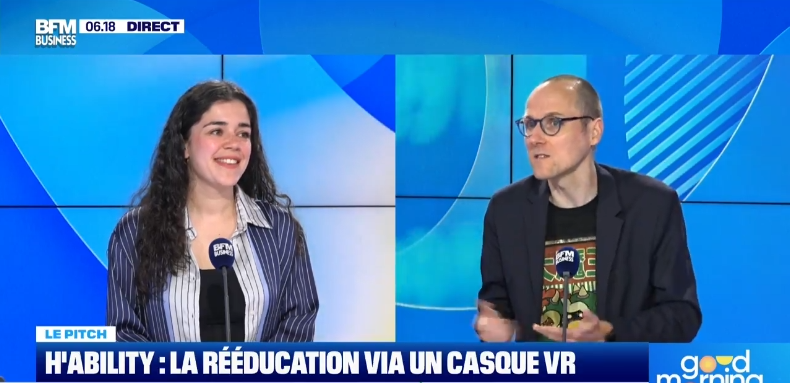
H’ability on BFM Business: virtual reality at the service of rehabilitation On May 12, 2026, H’ability was the guest of…
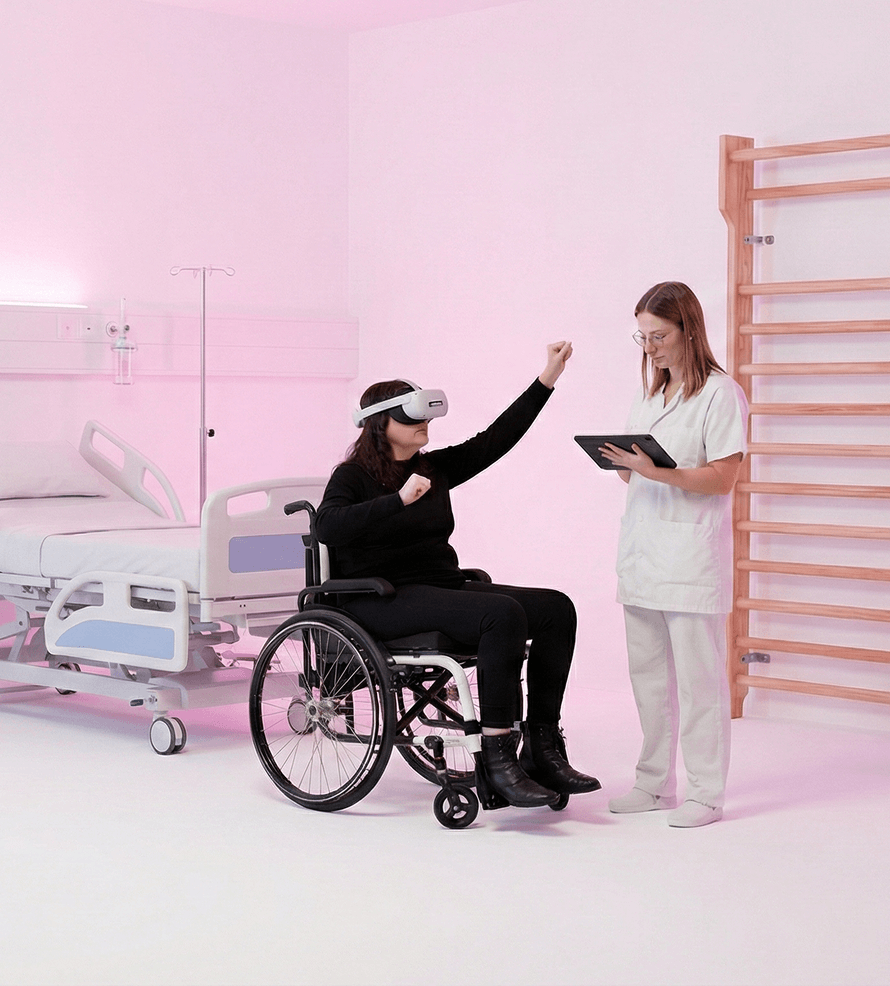
The career of Blandine Le Mené, a private occupational therapist, and her use of virtual reality How can virtual reality…