Post-stroke journey: the disruption of the return home and the solutions
Every year in France, stroke affects about 150,000 people and is the leading cause of acquired disability in adults. While…


H’ability is taking a new step in its commitment to ageing well. Through the H’ability Home project, the company is part of the France 2030 program dedicated to digital medical devices for the elderly. The objective: to offer post-stroke rehabilitation at home to elderly patients, in an immersive and motivating setting, while keeping them monitored by their health professional. This article presents this project and the clinical study that accompanies it.
The ageing of the population is one of the major societal challenges of our time. To respond to this, the State has launched, as part of the France 2030 Medical Devices Plan, a call for projects dedicated to digital medical devices for the elderly and ageing well.
The ambition of this program is twofold: to support innovation in digital health, and above all to generate robust clinical evidence through methodologically rigorous studies. It is in this dynamic that the H’ability Home project, led by H’ability, is part of this dynamic.
This commitment reflects a strong conviction: technological innovation has value in health only if it is scientifically evaluated and truly useful to patients and caregivers alike.
Stroke is the leading cause of acquired disability in adults. In France, there are about 140,000 new cases per year, or a stroke every four minutes. The elderly are particularly at risk, age being the main risk factor, with an incidence that increases sharply after the age of 65.
The consequences are serious: two-thirds of people who have suffered a stroke live with a moderate to severe disability. To limit this functional impact, rehabilitation plays a key role in improving autonomy and quality of life, especially in elderly patients.
But a problem persists. After discharge from the hospital or care centre, rehabilitation must continue at home. However, lack of motivation, fatigue and constraints in accessing care often compromise this continuity. It is precisely this need that the H’ability Home project intends to address.
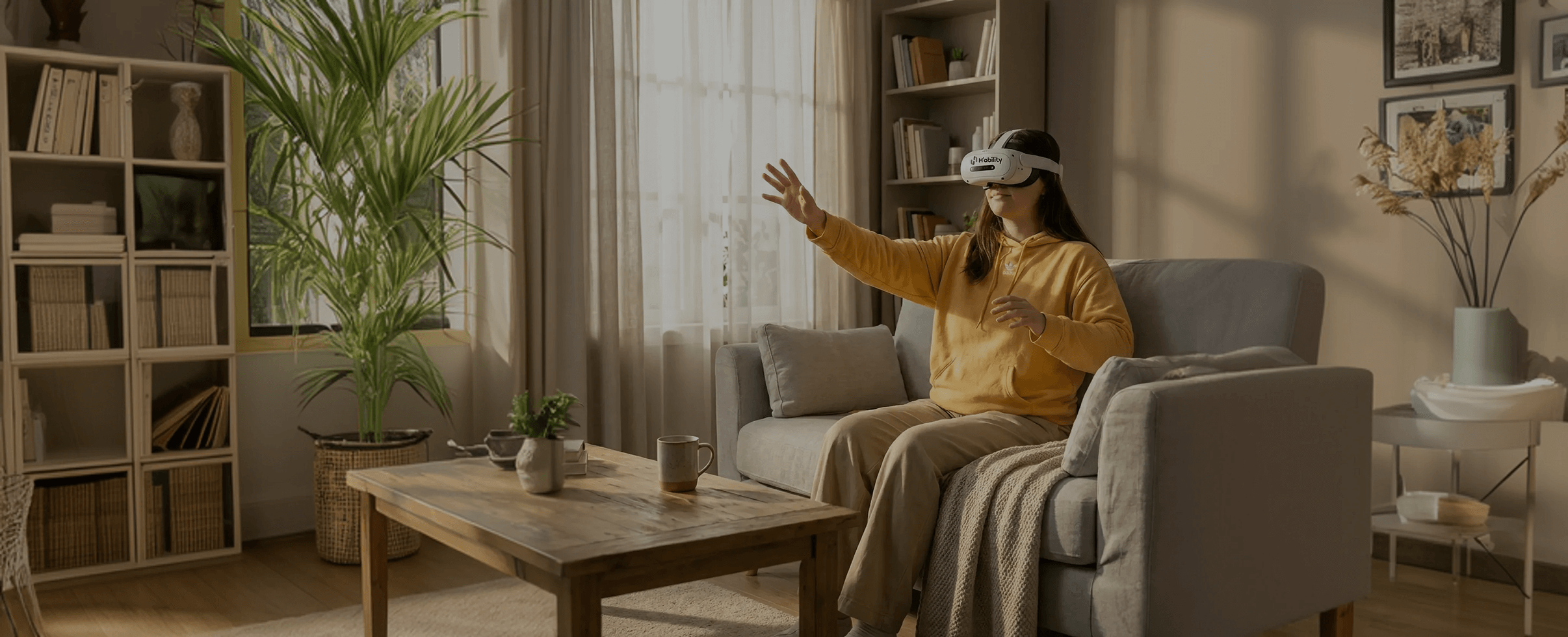
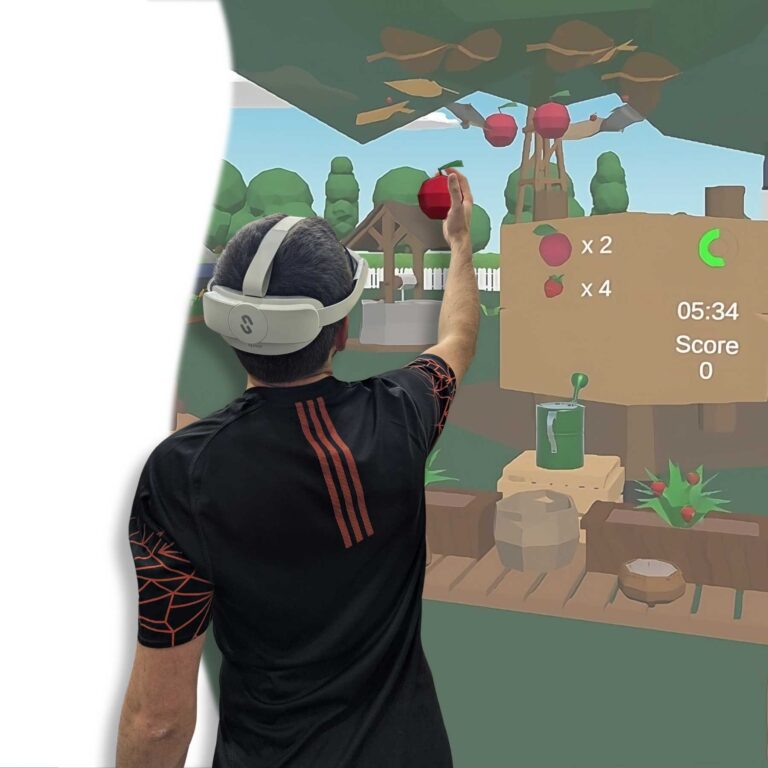
H’ability Home is a virtual reality rehabilitation solution designed specifically for elderly people who have suffered a stroke. Its principle is to allow the exercises to be carried out directly at the patient’s home, in a safe environment adapted to their abilities.
The operation is based on a clear distribution of roles:
This approach promotes adherence to care, helps reduce kinesiophobia (fear of movement) and supports functional recovery. By tailoring the journey to each patient’s abilities and motivation, the solution helps maintain long-term engagement — a key driver of outcomes. To discover the device, check out our virtual reality solution for rehabilitation.
It is important to remember that H’ability Home is a medical device whose home use remains supervised by a health professional, who prescribes, configures and supervises the rehabilitation remotely.
What distinguishes the H’ability Home project is its scientific roots. Virtual reality already has institutional recognition: in 2022, the French National Authority for Health (HAS) recommended virtual reality as a complement to other motor rehabilitation methods, in particular to improve the function of the upper and lower limbs in the chronic phase of stroke.
To go further, H’ability is planning a randomized controlled clinical study (RCT) to rigorously evaluate the effectiveness of H’ability Home on the motor recovery of elderly post-stroke patients, compared to standard rehabilitation. The study will rely on validated endpoints, such as the Fugl-Meyer Scale motor score, and will also measure the quality of life, motivation and satisfaction of patients and caregivers.
This study is being conducted in partnership with the Digital Medical Hub, a CRO (clinical research organization) experienced in the evaluation of digital medical devices, which will ensure scientific conduct and compliance with regulatory and ethical requirements.
Beyond the technological dimension, the H’ability Home project responds to a societal challenge: to allow the elderly to maintain their autonomy for as long as possible, in their usual environment. By facilitating the continuity of rehabilitation at home, the solution helps to limit the loss of learning and support the return to everyday life. To learn more about the clinical situations involved, see our therapeutic indications.
What is the France 2030 Ageing Well programme?
France 2030 Ageing Well is a call for projects from the State, carried out as part of the France 2030 Medical Devices Plan. It aims to support digital medical devices serving older adults and generate robust clinical evidence through methodologically rigorous studies.
What is H’ability Home?
H’ability Home is the virtual reality home rehabilitation solution developed by H’ability. It allows the elderly, especially after a stroke, to continue their exercises at home, in a fun and personalized way, while the caregiver plans and monitors the sessions remotely via a secure platform.
Why is stroke rehabilitation at home important for older people?
After discharge from a care facility, post-stroke rehabilitation must continue at home. However, lack of motivation and constraints in access to care can compromise this continuity, particularly among the elderly. Thus, an at-home solution helps to maintain patient engagement and autonomy.
Is virtual reality recognized for post-stroke rehabilitation?
Yes. In 2022, the French National Authority for Health (HAS) recommended virtual reality as a complement to other motor rehabilitation methods, in particular to improve the function of the upper and lower limbs in the chronic phase of stroke.
How does H’ability evaluate the effectiveness of H’ability Home?
H’ability is planning a randomized controlled clinical study (RCT) to evaluate the effectiveness of H’ability Home on motor recovery in elderly post-stroke patients, compared to standard rehabilitation. Indeed, this study is being conducted with the Digital Medical Hub, based on validated criteria such as the Fugl-Meyer scale.
References:
Every year in France, stroke affects about 150,000 people and is the leading cause of acquired disability in adults. While…
Chronic low back pain is one of the main reasons for physiotherapy consultation and one of the leading causes of…

H’ability on BFM Business: virtual reality at the service of rehabilitation On May 12, 2026, H’ability was the guest of…
The career of Blandine Le Mené, a private occupational therapist, and her use of virtual reality How can virtual reality…