Post-stroke journey: the disruption of the return home and the solutions
Every year in France, stroke affects about 150,000 people and is the leading cause of acquired disability in adults. While…


Parkinson’s disease is a progressive neurodegenerative disease that affects nearly 200,000 people in France. Beyond drug treatment, rehabilitation plays a central role in maintaining patients’ autonomy. Among the emerging approaches, virtual reality is attracting growing interest in the community of physiotherapists and occupational therapists. What does science really say about its effectiveness? This article takes stock of the available clinical data and the concrete applications of the H’ability device for your Parkinson’s patients.
Parkinson’s disease is characterized by a triad of motor symptoms : tremors at rest, muscle rigidity, and bradykinesia (slowness of movement). In addition to these symptoms, there are problems with balance, walking and cognitive functions that considerably increase the risk of falls and loss of autonomy.
However, conventional rehabilitation faces two major obstacles. On the one hand, it requires intensive repetition of exercises to induce long-lasting neuroplasticity. On the other hand, patients’ motivation tends to erode over the course of the sessions, which reduces treatment compliance in the medium term.
This is precisely where virtual reality comes in. Indeed, it makes it possible to combine training intensity, real-time feedback and patient engagement in an immersive environment that diverts attention from motor impairment.
The scientific literature on this subject is now solid. For example, a meta-analysis published in 2023 in the Journal of NeuroEngineering and Rehabilitation (Kwon, Park & Koh) confirms that virtual reality rehabilitation significantly improves balance function in Parkinson’s patients compared to conventional treatments alone. This meta-analysis analysed all available randomised controlled trials up to May 2022.
In addition, a randomized controlled trial by Feng et al. (2019) on Parkinson’s patients shows that VR rehabilitation improves BBS (Berg Balance Scale), TUGT (Timed Up and Go Test) and UPDRS3 (motor assessment) scores compared to conventional physiotherapy alone. In addition, patients who received VR had a better quality of life at the end of the protocol.
Finally, a more recent study by Kashif et al. (2024) compares three therapeutic approaches in Parkinson’s patients: VR alone, motor imagery alone, and routine physiotherapy. The result: the combination of VR + routine physiotherapy is the most effective in improving balance, motor function and activities of daily living.
Beyond the figures, here is what virtual reality vestibular rehabilitation brings to the management of Parkinson’s disease:
The H’ability device offers several categories of exercises directly applicable to Parkinson’s patients:
Some advanced Parkinson’s patients have significant postural instability that requires enhanced supervision during VR sessions. The mixed reality mode integrated into the H’ability device is particularly suitable in this context: the patient sees his or her real environment constantly, which reduces the risk of imbalance and reassures reluctant patients. In addition, the H’ability device is not indicated for patients with severe behavioral disorders.
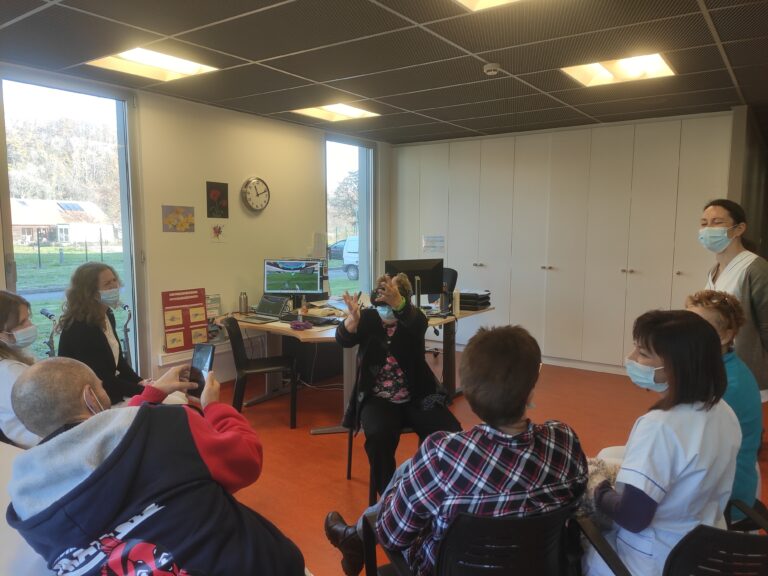
« Avec H’ability, la personne peut effectuer des mouvements dans un environnement sécurisé. C’est souvent source d’émerveillement pour eux de réaliser qu’ils ont réussi un geste, et sans avoir eu mal, sans qu’ils s’en soient rendu compte pendant l’exercice. »
— Ninon Playe, occupational therapist, LADAPT de l’Aube
What is Parkinson’s rehabilitation in virtual reality?
Parkinson’s rehabilitation in virtual reality consists of using a VR headset to offer the patient immersive exercises targeting balance, walking, fine motor skills and cognitive functions. In other words, it complements conventional physiotherapy by providing motivation, objective feedback and neurological stimulation.
Is virtual reality effective for Parkinson’s disease?
Yes. A meta-analysis by Kwon et al. (2023) confirms that virtual reality rehabilitation significantly improves balance in Parkinson’s patients compared to conventional treatments alone. In addition, several randomized controlled trials show improvements in walking and motor skills.
What Parkinson’s symptoms can VR improve?
Virtual reality mainly affects balance, step length, walking speed, upper limb motor skills and cognitive functions. Some studies also show effects on neuroplasticity and brain functional connectivity. However, the results on walking speed alone remain less significant according to the protocols.
How many VR sessions does it take for a Parkinson’s patient?
The protocols studied vary between 10 and 36 sessions, at a rate of 3 to 5 sessions per week. In practice, the first improvements are usually seen after 4 to 6 weeks of regular rehabilitation. That’s why consistency is a key factor for success.
Does VR replace conventional physiotherapy for Parkinson’s?
No, virtual reality is not a substitute for physiotherapy. It completes it by bringing an immersive, motivating and objective dimension. On the other hand, the best results are obtained by combining VR and conventional physiotherapy, as shown by several randomized controlled trials, including that of Kashif et al. (2024).
References:
Every year in France, stroke affects about 150,000 people and is the leading cause of acquired disability in adults. While…

Chronic low back pain is one of the main reasons for physiotherapy consultation and one of the leading causes of…

H’ability on BFM Business: virtual reality at the service of rehabilitation On May 12, 2026, H’ability was the guest of…
The career of Blandine Le Mené, a private occupational therapist, and her use of virtual reality How can virtual reality…