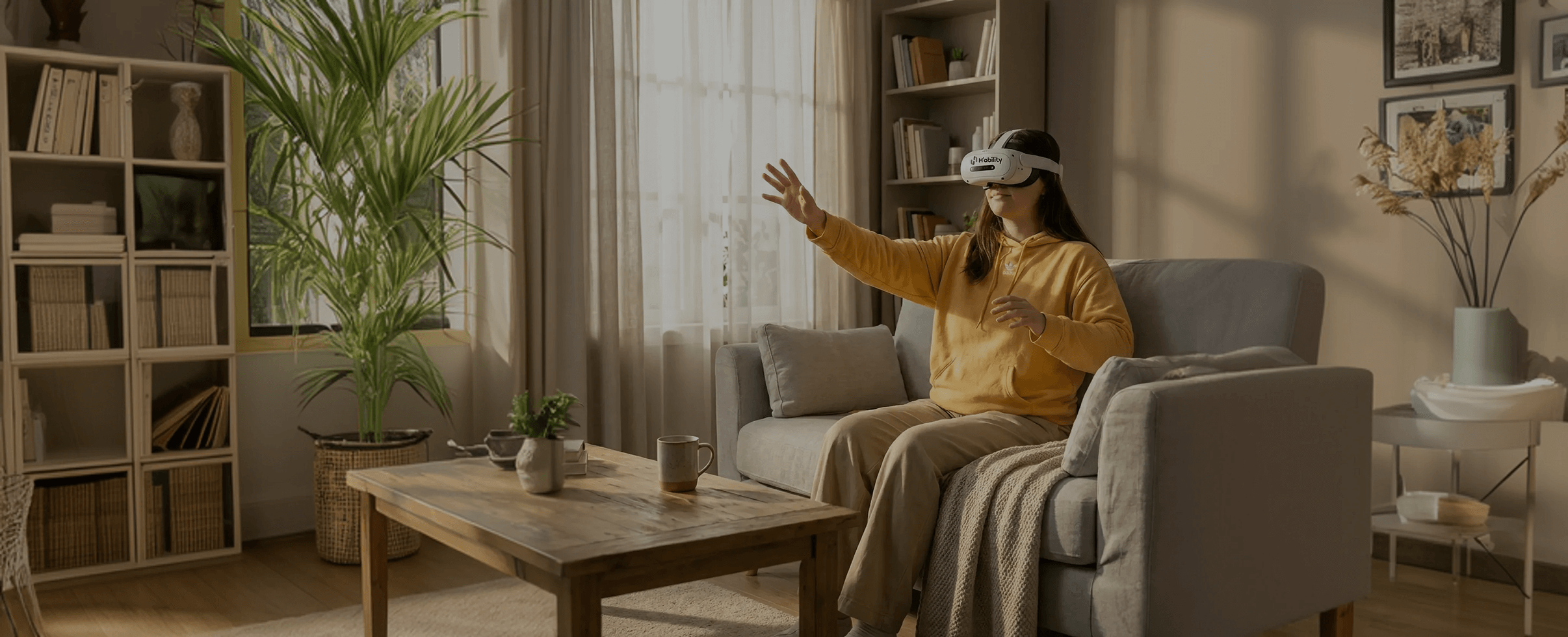
Post-stroke journey: the disruption of the return home and the solutions
Every year in France, stroke affects about 150,000 people and is the leading cause of acquired disability in adults. While…


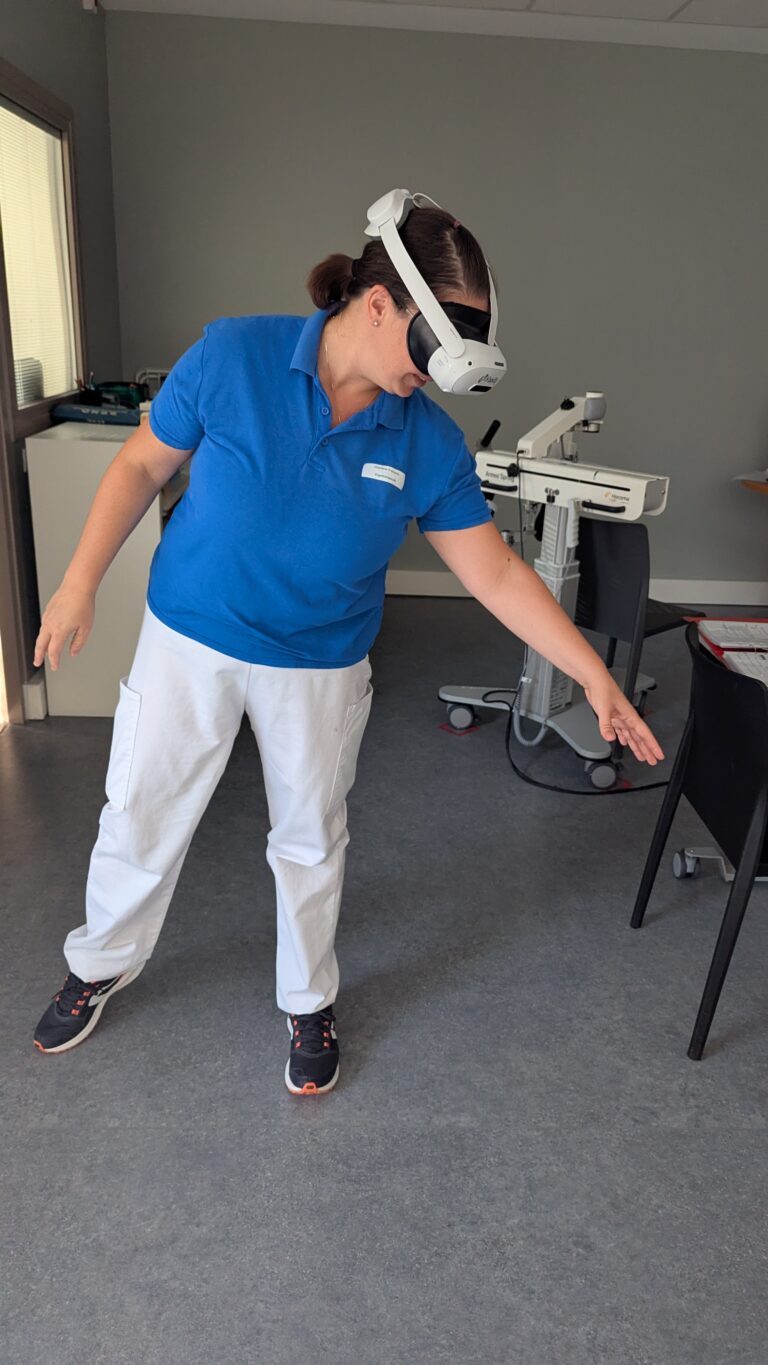
Mixed reality, or MR, is one of the most promising innovations for rehabilitation. More advanced than classic virtual reality for many clinical cases, it allows the patient to see his or her real environment while interacting with superimposed virtual elements. But what does science say about its effectiveness? And what concrete applications for physiotherapists and occupational therapists? This article provides an update on the clinical evidence and benefits of the H’ability device’s built-in mixed reality mode.
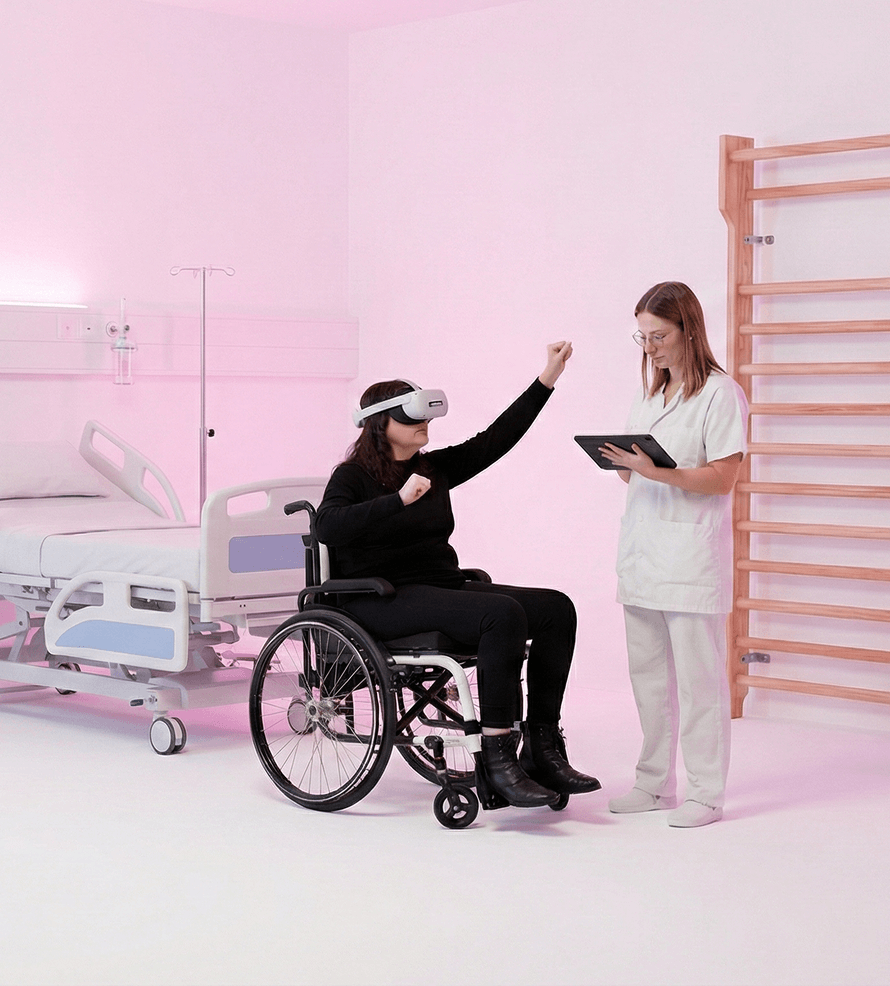
Mixed reality (MR) is a technology that combines, in real time, the patient’s physical environment with superimposed digital elements. In concrete terms, the patient wears a headset equipped with cameras that transmit the image of the real world, to which are added virtual objects with which he can interact. He therefore sees his body, the practitioner, the treatment room… and the virtual elements of the rehabilitation protocol.
This technology differs from two other approaches that are often confused:
In practice, the boundary between AR and RM is sometimes blurred in the scientific literature. However, what matters for rehabilitation is the preservation of the patient’s real landmarks — a major clinical advantage that we will detail below.
Mixed reality rehabilitation has several clinical benefits that pure VR cannot offer. Indeed, these advantages are now documented in the scientific literature.
First of all, patient safety is enhanced. As Vinolo Gil et al. (2021) point out in their systematic review published in JMIR Serious Games : VR cannot recognize real dangers that can cause injury, whereas in mixed reality, the patient remains aware of the risks of their environment. This difference is crucial for patients at risk of falling, the elderly and patients in the post-operative phase.
In addition, cyberkinetosis is significantly reduced. By preserving actual visual cues, MR limits the sensory conflict between the visual system and the vestibular system — the main culprit in VR-induced nausea. This is why the H’ability device favours mixed reality mode for patients who are vestibular, sensitive or reluctant to VR.
Then, interaction with tangible objects becomes possible. The same review confirms this: mixed reality offers superior proprioceptive feedback because the participant can interact with the application, the environment and tangible objects. This opens up valuable clinical possibilities, such as combining immersive rehabilitation with weighted weights, rubber bands or a harness.
Finally, patient engagement is greatly improved. In several studies analyzed by Vinolo Gil et al., participants reported higher motivation and adherence during MR/AR sessions compared to conventional exercises.
The literature on mixed reality in rehabilitation has been considerably enriched in recent years. Here are the main facts that practitioners can remember.
The systematic review with meta-analysis by Vinolo Gil et al. (2021), conducted on 11 randomized clinical trials and 308 patients, concludes that augmented and mixed reality, in addition to conventional physiotherapy, is effective in several areas:
More recently, Farsi et al. (2025), in a scoping review published in Sensors, analyzed 105 studies on RA/MD in motor rehabilitation. They confirm the rapid expansion of this technology, with a dominance of head-mounted displays (56.2% of studies) — such as the Pico 4 Enterprise headset used by H’ability.
However, these reviews also highlight the current limitations: heterogeneity of protocols, often small sample sizes, and the need to conduct larger clinical trials. Thus, mixed reality does not replace conventional physiotherapy: it complements and enriches it.
The mixed reality mode integrated into the H’ability device applies to the entire catalog of rehabilitation exercises. Here are the most relevant uses identified by the partner practitioners.
To discover all the clinical situations, consult our page dedicated to H’ability therapeutic indications.
A typical session with the MR mode of the H’ability device lasts between 15 and 30 minutes. The practitioner simply activates the MR mode from their tablet interface, and the Pico 4 Enterprise headset switches to mixed reality. The patient then sees the room, the practitioner and his own body, enriched with the virtual elements of the chosen protocol. All data (kinematics, scores, reaction time) is recorded in real-time for monitoring.
“With mixed reality, the patient remains in their usual environment — they see their body, the room, the real landmarks — while benefiting from an enriched work environment.”
— Dr. Frank Wein, Sports and Knee Surgeon, H’ability Co-Developer
What is mixed reality in rehabilitation?
Mixed reality combines the patient’s real environment with virtual elements overlaid in real-time. The patient sees his body, the practitioner and the room, while interacting with virtual objects displayed in his field of vision. In other words, it differs from pure virtual reality in which the patient is fully immersed in a digital environment.
What is the difference between mixed reality and virtual reality in physiotherapy?
Virtual reality isolates the patient in a fully digital environment. On the other hand, mixed reality retains the real landmarks: the patient sees his body, the ground, the practitioner. This difference is crucial for patients at risk of falling, the elderly, and patients susceptible to motion sickness.
Is mixed reality effective in rehabilitation?
Yes. A systematic review with meta-analysis (Vinolo Gil et al., 2021) shows that augmented and mixed reality, in addition to conventional physiotherapy, improves balance and fall prevention in geriatrics, as well as limb functionality after stroke. In addition, a recent scoping review (Farsi et al., 2025) confirms the rapid expansion of this technology in motor rehabilitation.
What are the clinical indications for mixed reality?
The main documented indications are balance rehabilitation in the elderly, fall prevention, upper and lower limb rehabilitation after stroke, treatment of phantom pain with mirror therapy, and vestibular rehabilitation. In addition, the H’ability scheme covers all these indications.
Does mixed reality reduce the risk of cyber motion sickness?
Yes. By maintaining the patient’s real visual cues, mixed reality significantly reduces the sensory conflict responsible for nausea induced by pure VR. This is why it is particularly suitable for vestibular patients, the elderly and all profiles sensitive to motion sickness.
References:
Every year in France, stroke affects about 150,000 people and is the leading cause of acquired disability in adults. While…
Chronic low back pain is one of the main reasons for physiotherapy consultation and one of the leading causes of…
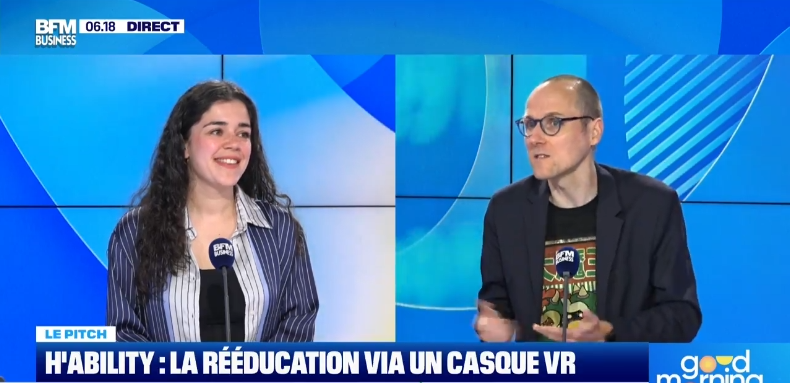
H’ability on BFM Business: virtual reality at the service of rehabilitation On May 12, 2026, H’ability was the guest of…
The career of Blandine Le Mené, a private occupational therapist, and her use of virtual reality How can virtual reality…