Post-stroke journey: the disruption of the return home and the solutions
Every year in France, stroke affects about 150,000 people and is the leading cause of acquired disability in adults. While…


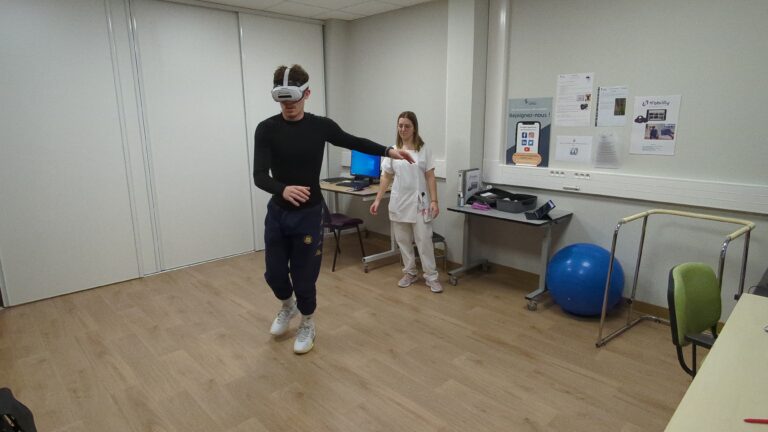
Returning to sport after an injury is one of the most delicate stages of the treatment journey. Only 24% of patients regain their pre-injury functional level after anterior cruciate ligament reconstruction — a figure that questions the quality of the current rehabilitation protocol. In this context, virtual reality is attracting increasing interest among sports physiotherapists and orthopaedic surgeons. Is the resumption of sport after injury really more effective with VR? And how can it be concretely integrated into a rehabilitation protocol? This article takes stock.
Sports injuries, and particularly anterior cruciate ligament (ACL) injuries, are a major challenge for physiotherapists. Every year, nearly 100,000 ACL reconstructions are carried out in Europe. Yet, according to data published in 2025, only 24% of patients return to their pre-injury functional level after reconstruction.
This statistic highlights the limitations of traditional protocols. Indeed, conventional rehabilitation (muscle strengthening, proprioceptive exercises, joint mobilization) is effective on physical parameters, but it struggles to reproduce three essential elements of the return to sport:
This is precisely where virtual reality brings added value. Indeed, it makes it possible to combine motor work, cognitive solicitation and an immersive environment in secure and reproducible conditions.
The scientific literature on this subject has been considerably enriched in recent years. Several recent meta-analyses now shed solid light.
The baseline meta-analysis is that of Tan et al. (2025), published in PLOS One. It compiles all available randomized controlled trials on VR after ACL reconstruction. The results are clear: VR significantly improves knee function (IKDC score: +4.23 points), walking ability, stride length (+3.99 cm) as well as the strength of the knee extensors and flexors. In practice, these gains translate into a faster and more complete return to sport.
In addition, Cortés-Pérez et al. (2025) published in Translational Sports Medicine a systematic review with meta-analysis confirming that VR reduces pain and improves knee function, muscle strength, range of motion, and dynamic balance after ACL injury. Level of evidence: II.
Finally, the landmark study by Gokeler et al. (2016), published in Knee Surgery, Sports Traumatology, Arthroscopy, demonstrated that immersive VR improves movement patterns in post-ACLR patients. This is crucial because movement pattern defects are one of the main factors in recurrence after a premature return to sport.
However, these reviews highlight an important limitation: VR is not a substitute for conventional rehabilitation. It acts as a complement, and it is the combination of the two that produces the best clinical results.
The H’ability system offers several categories of exercises directly applicable to the return to sport protocol:
For an overview, see our H’ability therapeutic indications.
For the athlete in the return to activity phase, the H’ability mixed reality mode brings an additional dimension. By maintaining the patient’s real visual cues, it makes it possible to combine virtual exercises with physical equipment: weighted weights, elastics, proprioceptive platforms. The athlete can thus gradually enrich the difficulty, while maintaining control of his environment — an essential point for patients at risk of recurrence.
Is virtual reality effective for the resumption of sport after injury?
Yes. A meta-analysis by Tan et al. (2025) demonstrates that VR significantly improves knee function, walking, muscle strength, and movement patterns after ACL reconstruction, compared to conventional rehabilitation alone. In addition, several studies show that VR promotes a return to sport in better conditions and reduces the risk of recurrence.
What sports injuries can benefit from VR in rehabilitation?
The main documented indications are: rehabilitation after ACL ligamentoplasty, post-operative follow-up of the knee and ankle, recurrent sprains, rehabilitation after hip or knee replacement, and shoulder pathologies in athletes. In addition, VR is effective on post-traumatic kinesiophobia.
How does VR help overcome kinesiophobia in athletes?
VR diverts the patient’s attention from the painful area to the success of a playful exercise. Indeed, studies show that this cognitive distraction reduces the perception of pain and the fear of movement, two major obstacles to returning to sport. Thus, the athlete gradually regains confidence in safe conditions.
When to integrate VR into the rehabilitation protocol?
VR can be integrated from the early postoperative phase for joint mobility, then intensified in the strengthening phase for proprioceptive work and coordination. Finally, in the phase of return to sport, it makes it possible to evaluate movement patterns and decision-making in conditions reproducing the practice of sport.
Does VR replace traditional physiotherapy in sports physiotherapy?
No. VR is a complement to conventional rehabilitation, not a substitute. In contrast, the best results are obtained by combining the two approaches, as confirmed by several randomized controlled trials. This is why it enriches the therapeutic arsenal of the physiotherapist by providing motivation, objective feedback and cognitive-motor work.
References:
Every year in France, stroke affects about 150,000 people and is the leading cause of acquired disability in adults. While…

Chronic low back pain is one of the main reasons for physiotherapy consultation and one of the leading causes of…

H’ability on BFM Business: virtual reality at the service of rehabilitation On May 12, 2026, H’ability was the guest of…
The career of Blandine Le Mené, a private occupational therapist, and her use of virtual reality How can virtual reality…